
(See the original post in LinkedIn here.)
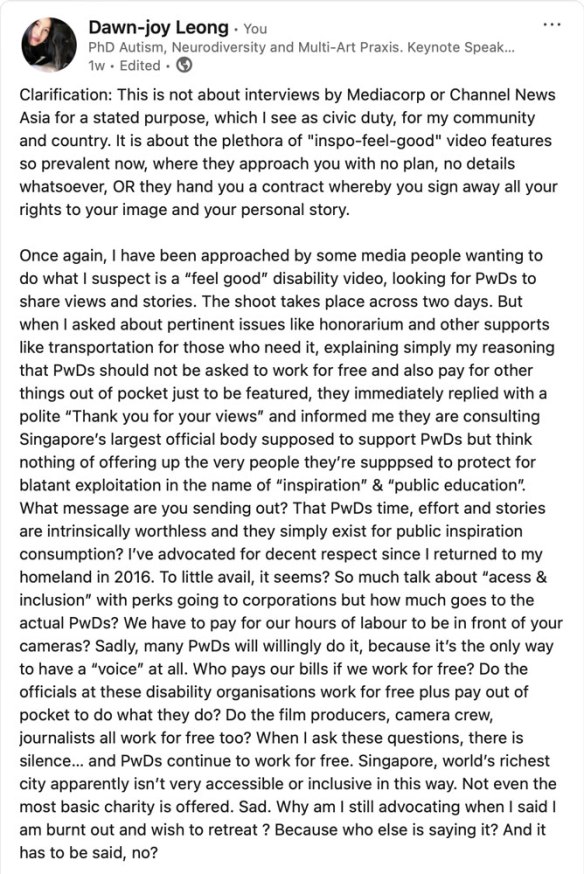
One week ago, I made the above post in LinkedIn. This issue has been something I have been trying to address since returning to Singapore in late 2016. Back then, “inclusion” was not the huge buzz-word that it is nowadays. Large Autism forums at the time were being held without a single Autistic person or Autistic researcher present in the room. The voices of persons with disabilities were seldom ever heard at all, although there were beginnings of ‘feel-good’, ‘nice-nice’, ‘be-kind’ videos floating around. Autism “awareness” was only about “lighting it up blue”, and information about autism was the domain of the non-autistic, self-styled ‘experts’ with degrees in psychology but not an iota of lived-experience at all.
Since then, much has changed. Autistic, deaf and disabled voices in Singapore have slowly emerged into the foreground. This is a great thing. I am unsure whether my robust, sometimes blunt and brusque fist-shaking had very much to do with instigating change, but I do know I did play some small part in the churning, swirling, stirring process, alongside a small group of brave and outspoken PWDs and allies from the Disabled People’s Association, other arts practitioners, and allies in the government. From the ground, I know our PWD+allies’ (some almost reckless) outspokenness has opened tiny holes in the thick fog for other younger advocates to step through, and there are many capable disability advocates now doing very well. It was truly a community effort, of which I was merely a tiny spark. I have left the Disabled People’s Association, our entire old Board of Directors stepped down and made way for a brand new team. I am hopeful that new energy will bring better conditions. But we still have a long, long way to go.
I could write an epic dramatic chapter about my adventures in advocacy in my home country, the support I received, as well as the disrespect and outright abuse I have encountered. Yes, I know, advocates simply have to grow very thick skins and remain focused. But advocates are human too, and humans suffer from burn out, especially Autistic humans. In particular, a reluctant advocate as myself. Many really great Autistic advocates own the label proudly, and they are good at what they do. Far better than I could ever be. Personally, I never felt comfortable with that label, even when people use it in a complimentary way. I am simply an ordinary human speaking out about injustice because I do not hear anyone else doing so. This includes fellow PWDs. Yes, I do understand, many do not want to because they feel they have a great deal to lose. And yes, I am in a ‘privileged’ position where I have nothing to gain, and therefore nothing to lose.
Somehow, this hidden aspect of disability discrimination remains shoved under the dusty carpets, while a whole lot of “glitz and glamour” is now being tossed out from every corner of the street. Everyone now wants to be part of the “inclusion” party.
This one blog post focuses on just two incidents that happened within a week of each other. There are many others from my great adventures but they will not fit into one blog post.
Last week, I received a message via Instagram from some person from a media company I’ve never heard of, asking me to participate in their video. They claimed to be collaborating with Singapore’s largest disability support organisation. Their call-out was haphazard, their language was what my generation would call “fresh”. Usually, when I encounter frivolous sounding “hello” types of messages on social media, I just delete and block, I have no time to make new “friends” that way. However, this was about a serious topic, i.e. voices of PWDs, and so, acknowledging to myself that perhaps I am rather old-fashioned and simply tired, I tried to respond as best as I could. I asked the person to supply more pertinent details, and their reply was to scuttle off into the foggy darkness with some excuse that they had not prepared anything whatsoever at this stage, it was simply a scouting expedition to see how many hungry hapless fish they could hook with their hazy, slapdash bait.
Well, I took to LinkedIn, of course, to air my frustration. That post garnered 3,997 impressions. Unexpected, as I never set much store on the ‘popularity’ of my posts, as history has shown me that my views and delivery tend to be a little too ‘piquant’ for mainstream society here. Why these people still want to seek me out to participate in their “feel-good disability awareness” parties, I have absolutely no idea. In any case, people from the large disability organisation (currently still being helmed by non-disabled people) contacted me, and we have had a few polite exchanges since. I am not holding my breath, but I still hold hope that someone will understand what I am trying to say and some change will some day come about.
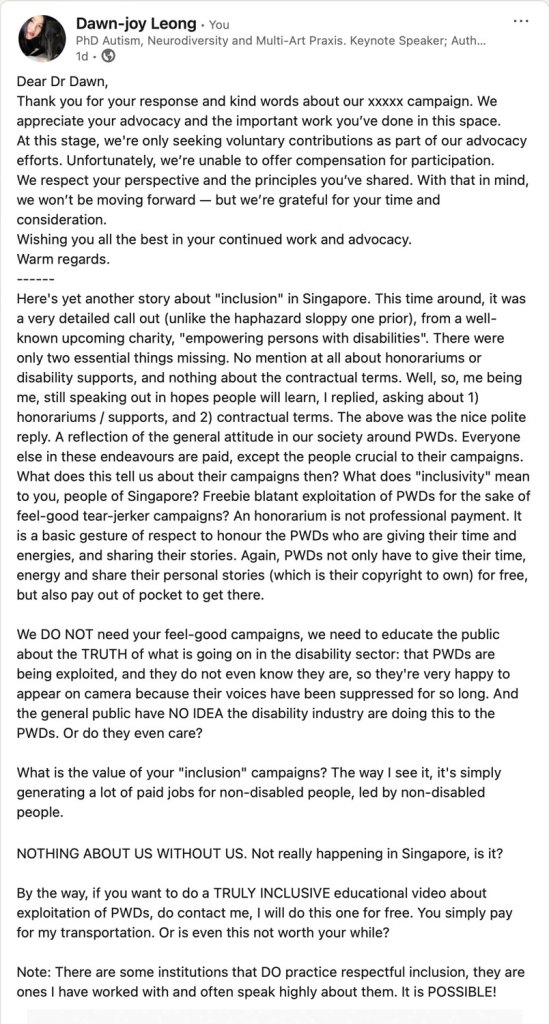
Anyway, less than a week later, I was once again approached by another entity from a newly formed charity who claim to be “dedicated to empowering persons with disabilities”, to participate in their own media campaign. Very slick, nicely polished their products look. This time, the call out was via email, and politely and professionally worded, with a great deal of detail. Sadly, two key pieces of information were missing. There was no mention of honorariums or supports for the PWDs participating, and nothing about contractual terms. In my reply, I praised the person for having written a very good call-out. I of course pointed out the two crucial missing pieces of the puzzle. But this time, perhaps because I was already quite exhausted from the previous encounter, I was a little cheeky. I informed the person that my professional fee was quite high, but I understood that this was a charity campaign and hence I was happy to consider participation if they could let me know what their honorarium would be. What I wanted the person to understand is that time, effort, energy of PWDs should be respected. A fundamental principle that people in the disability industry in Singapore do not seem to grasp. Every media company making feel-good videos feels entitled to the time, effort and energies of PWDs without any need for even the smallest gesture of regard or appreciation. On top of that, they will not even include transportation support. Filming takes time. I’ve done such freebies before, in the first few years of my return to my homeland. I did that because I wanted sincerely to create greater awareness and recognition for PWDs, in what was at the time a barren landscape. That was nine years ago. Now, PWD visibility is at an all time high, it has become almost ‘trendy’ to claim to be “inclusive”. But these “inclusive” efforts are still not honouring the time, efforts and energies of the PWDs they are claiming to “include”. An honorarium is not professional payment. It is nothing grander than a small gesture of appreciation. What is a $50-$100 honorarium per PWD to your company? Why did you not budget for simple gestures of respect and honour from the very start? Did it never occur to you? Is this the measure of your esteem for the subjects you are using to create your fabulous little programmes? A plethora of questions arise…
(See the original post in LinkedIn here.)
The saddest part of this is that these exploitative ventures always find enough PWDs to participate, often enthusiastically too. Why? Because PWDs have been oppressed, repressed, hidden and silenced for so long that any chance to be aired outside the dusty closet is welcome. And how can I blame them? They will not dare to ask for any rights, any respectful gestures, because they know they will be cast aside and there will be plenty of others waiting in line, willing to be part of this grand assortment of non-disabled-led disability shows. How many PWDs would even speak out this way? They have too much to lose. The plight of speaking out as a PWD is not only clear in my country. Even experienced professionals internationally fear revealing their Autistic identities for fear of stigma, discrimination and losing their high paying jobs. Here in my country, most PWDs do not even have jobs at all, and those who do, are usually employed in the Food and Beverage industry, or lower executive positions in corporations that receive encouragement from the government for hiring PWDs in the name of “inclusion”. I see what is at stake.
Mindsets are the most difficult to change. As long as PWDs are willing to be disrespected just so they can have their 15 seconds of airtime, (or they do not even know they are being disrespected because nobody ever educated them about what respect really means), and as long as companies and organisations are empowered by this gaping hole in the inclusion clouds to exploit PWDs for their own displays, I know I am fighting a losing battle.
This most recent turbulence in the giant stew pot comes at a time when I am experiencing a prolonged bout of illness. I am forced to ask myself some tough questions.
There is absolutely nothing in this for me. Neither loss nor gain at best, and at worst, it has cost me time, effort, energy and yes, destabilised my already fragile health. Is it even worthwhile continuing to throw myself into such contentious and potentially self-destructive situations with this level of sincerity and passion for a cause that is clearly not popular? Perhaps not. I don’t want to be a hero. I have a multitude of other things to pursue, all of which bring me much joy and fulfilment. But my conscience asks that awkward other question: If I do not speak out while I can, then who will?
Will you? Please do.
[Note: There are organisations and entities here in Singapore who do practice true inclusion and do show respect to PWDs who participate in their projects. They are few and far between, but their continued existence brings me hope for the future. Perhaps a future I may not see, not in my life time, but hope lives. And maybe this is why I keep doing what I do?]
 Dawn-joy Leong