I will be giving a public talk in Melbourne, Australia, on 1 December 2025. Tickets are free. An event organised by Care and Repair: Rethinking Contemporary Curation for Conditions of Crisis – a joint research project between Monash University and RMIT University funded by the Australian Government through the Australian Research Council.
Come find out all about my current mutli-acces, multimedia memoir-fantasy, named in honour of my beloved Lucy Like-a-Charm. If you are in Melbourne, do please drop by and say hello!
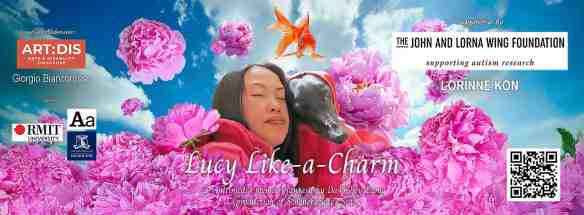
Lucy Like-a-Charm memoir-fantasy project is supported by The John and Lorna Wing Foundation, Ms. Lorinne Kon, and creative collaborator ART:DIS Singapore, with Giorgio Biancorosso, RMIT University, University of Melbourne.
Excerpt from Project WebPage: Lucy Like-a-Charm. Please visit this link for full information.
Presenting my latest project…
Lucy Like-a-Charm
– a multimedia, multi-access memoir-fantasy about an Autistic woman and a Greyhound dog on a magical journey towards Becoming – empowered by Love, transformed by Grace.
It’s almost the end of April, and I have been trying to post a daily personal thought-piece on Linked-In on my “taking up space” as a proudly Autistic human in this grand swirl of humanity. Why Linked-In? Simply because I wanted to. Yes, I know it’s not really the kind of thing people post on Linked-In. I see that I am once again doing something almost nobody else is doing. But I am not bothered if nobody reads it or likes it or whatever. I am merely taking up space, holding space, nothing more grand, clever or fanciful. Lucy taught me how to enjoy a posture of meekness without relinquishing enjoyment and security in one’s unique Beingness. It is possible. Not always “comfortable”, but it is another form of Clement Space to me. I thrive better this way. Thank you, Lucy.
I am also wanting to do my part this April, as an Autistic human, in a month that is controversial – loathed by some Autistics and welcomed by others, the latter especially in my region of the world. But not as an Advocate, a label that was placed on me that I never asked for. The hat just did not fit well at all, though I wore it as best as I could, especially in my country when I first returned from Australia, when there was nobody else to stand in the gap. Now, I see there are many powerful advocates, the field of advocacy does not need me, not even in my own country anymore. To be honest, I am relieved. I have been on social media since the days when Facebook began as an invitation-only platform, and blogging was the only way to reach and connect with other Autistic humans. Back then, I did not worry about ‘likes’ of ‘followers’, I don’t think it was even a ‘thing’ at the time. I never did put much importance in this, I was reticent even when the ‘following’ and ‘liking’ started to trend into a full blown slugging match, though I did think that I ought to get in on the act a bit more, but of course failed miserably because my heart and soul were not aligned with that movement anyway, and now, at this point of my journey, it completely does not matter at all. The only caution and thought I have learned through the years to exercise is for my own safety and privacy, because there is so much that is awful about social media these days. For me, I maintain a presence because I want to, and because it is easier to update my few friends and supporters this way, but my main focus is on being a witness to my own journey, telling my personal story wherever I am welcomed, at every interstice I possibly can. My mission is simple. I do all nowadays in honour of Lucy Like-a-Charm, who showed me another dimension of perceiving, receiving and living, and how to be human in my own best possible way. I admit that the ability to choose this path is a luxury and privilege for which I remind myself to be grateful always. I just want to tell our story, nothing more.
This thought-piece is about my personal experience of the observation and upholding of diversity, equity, and inclusion, and receiving the supports I requested, during my latest adventure in Salzburg.
If you are an artist with disability and would like to learn about disabled leadership in the arts, do apply for SYNC Singapore 2025! (Spaces are limited and subject to selection process by ART:DIS.) Expression of Interest Form is here.
Programme for SYNC on 26th March 2025, 0930-1830 as follows:
ART:DIS X SYNC LEADERSHIP TRAINING
Building Leadership Influence, Inclusive Cultures, and Impact for D/deaf, Disabled and Neurodivergent Creatives in Singapore
Note: This is only open to disabled artists, and by selection through an ‘Expression of Interest’ (EOI). Please fill in the attached form to be considered.
Deadline: Thursday, 13 March 2025 Offer of Acceptance: Thursday, 20 March 2025
Mandatory Attendance is required for:
1) ARTDIS x Sync – Masterclass 1 & 2 Wednesday, 26 March 2025 9.30am – 6.30pm In-person At Nanyang Academy of Fine Arts (NAFA) Exact address, TBC
2) ARTDIS x Sync – Masterclass 3 Saturday, 26 April 2025 4.00pm – 8.00pm Online through Zoom Meeting link, TBC
Focus: How to connect with your Leadership Drivers & Styles Objective: To drive and change your world
You will learn how to –
Arrive at a Personal Manifesto for your own arts leadership.
Construct and tell Leadership Stories centred on what drives and progresses you.
Engage with your Leadership Drivers, and understand yourself and your story better.
Explore Leadership Styles to act on those Drivers so you can be more authentic and make a greater impact to build your purpose and practice.
MASTERCLASS 3:
Focus: How to Influence and Instill Inclusive Cultures Objective: To build your allies, partners and supporters
You will learn how to –
Develop your own way of Influencing that builds momentum and makes an impact – from small persuasive acts to big strategies for change, you can helm your path and push through, and learn from what has worked.
Identify Different Considerations if you’re D/deaf, disabled or neurodivergent working in arts and culture.
Recognise the 6 traits of Inclusive Leadership and Adaptive Leadership theories and practices, and how to apply them.
As promised to some of my friends and followers of my pages, blogs and website, here is the transcript of my convocation speech tonight at the SUSS Convocation 2023: Session 3 – Undergraduate Programmes (NSHD). The Youtube ‘live’ video (link below) does not have captions, so I have put my transcript here.
Mr Aaron Tan, Member of SUSS Board of Trustees; distinguished guests, graduates, ladies and gentlemen, thank you for this honour. My heartiest congratulations on this very special occasion.
I cannot tell you how to make a lot of money, rise up the corporate ladder, or how to achieve worldly success. I have never managed any of these. I owe my very existence today to a few loyal friends, my one supportive sister and a gentle yet magnanimous creature called Lucy Like-a-Charm, a Greyhound rescued from the cruel racing industry in Australia.
(Slide 1 – Lucy Like-a-Charm, a black Greyhound is lying on a white puffy quilt, head upright, looking at camera, ears perked up and spread out, mouth open in a happy smile.)
So, what can an ordinary person like me bring to this milestone occasion? Please allow me to share a glimpse of my life’s journey. I was born in 1965, the year of Singapore’s independence. Like many in my generation, I found out my Autistic identity only in my early forties. I’ve also struggled with a lifelong, painful medical condition.
Apologies for the late post. This is my latest article for the National Gallery Singapore, about creating Clement Space in public places – conducive environments for restoration and respite – that is accessible and inclusive. Please click on title that will link to the article on the NGS website.
I always enjoy working with veteran director and theatre maestro Peter Sau, probably the only director in Singapore that I love working with, because he understands my artistic/creative foci and my needs arising from my disabilities.
Here’s a video clip of my performance at the Singapore Writers Festival 2022 presented by ART:DIS, directed by Peter Sau. Small bits of it have been edited out, but it’s mostly intact. Watch it on ART:DIS’ Instagram page. The beautiful soundscape is by the talented Niran Jierapipatanakul, intern at ART:DIS.
For those Deaf/deaf and hard of hearing, or those unable to make out the spoken word because of the echo in the soundtrack, here is the script. For the blind/visually impaired, the sharp sounds you hear intermittently are made by my placards of key words falling to the ground.
This comes one year and six months late. So much has happened since, so many more adventures, and a few misadventures too. But delay and slow churning is part of how my Autistic brain works – every little detail is taken in, stored, ruminated over and slowly teased apart, and this is why I need a lot of time to ponder the great many threads and trajectories and to ‘grow’ these tendrils in my mind, nurturing them into larger conjoined structures.
I’ve been revisiting some events and work that I’ve done in recent years and thinking about issues of access yet again. One show that marked a very strong and visible stride into opening up the meaning of ‘inclusion’ in practice was “Something About Home“.
“Something About Home”, commissioned by the National Gallery Singapore, premiered on 11 January 2020. Singapore’s first promenade theatre performed by a cast of all disabled artists. Conceptualised and directed by theatre maestro Peter Sau, now Head of Performing Arts and Programme Director at ART:DIS.
Access and inclusion?
There are many things I have to unpack about my experience in this work – in which I played two different roles – but I’d like to only focus on just one: inclusion. What does ‘access and inclusion’ look like? To be honest, there is not a single framework cast in stone, and most interpret and improvise as they see fit, or as it fits in with their personal, organisational, political or corporate agendas. This is my own professional and personal opinion, and perception of how I’d like access and inclusion to look like, at a very basic level at least. Of course, I am still learning, and my views may change as my understanding and experiences develop.
Because of my combined sensory acuity and compromised immunity, Peter came to my home for pre-rehearsal sessions, where I practised with him separately from the rest of the cast. This was a make-or-break point of support for me. If I had to rehearse with everyone all the way, I would not have taken on the project. As it happened, the combined rehearsals and team sessions were quite excruciating, even though we had plenty of sensory breaks and the schedules were planned such that everyone’s needs were carefully considered. My senses always scream whenever I am trapped inside the vortex of human bodies, in crowded shopping malls or events, moving around, talking at once. Add to the mix the human smells – some really pretty confronting, especially after everyone has had really long days. Well, our full rehearsals were intense, and I had to deal with all of the above, our human forms crammed together in a small space, plus additional odours emanating from the carpet, echoes and reverberations bouncing here, there, everywhere in a confusing cacophony, and then, to top it all, I had to muster the inner energy required for my role. Theatre is a jumble of bodies, it is not an art for the hypersensory or the physically fragile. I get that, which is the reason I never aspired to become a professional actor. I’m acting enough, as it is, being Autistic and female, according to my own favourite quote I coined, constantly “performing the unnatural as naturally as possible.” And I am physically frail, most unsuited for the theatre. Yet, when it all comes together, it is immensely satisfying.
In professional artistic practice, or any professional practice across all fields, ‘inclusion’ does not mean mollycoddling and fancy frills. I still had to push myself very hard, and even beyond what I was comfortable with. What kept me going throughout the intensely challenging rehearsals was the director’s dedication, the knowledge that he was going as far as he possibly could go to practise access and inclusion, with a keen, meticulous eye for detail. Peter was mindful of each individual, while at the same time, the entire team were united under a strong ethic, a highly skilful and very firm leadership. To be frank, I’m not really a rebel for the sake of rebellion. I am actually extremely compliant, but only if the leader can show me good reason for my compliance. I’m lucky to have worked with a few such leaders, and Peter has now been added to this list of honour.
Remuneration as a tangible form of access and inclusion. A fundamental of respect.
Most entities – especially enterprises that need to meet the bottom line financially – are focused on how to pay the artists the least possible for the best possible result. I have done work for some for a pittance or even nothing, because I liked what they were doing for the community at large; and I have rejected some others that I felt crossed the line into exploitation and bullying. It is understandable, of course. Colonialistic domination is really how most industries operate, and the arts industry is no different. However, working with Peter Sau in Something About Home was different. I discovered that we share a similar work ethic where it comes to others we work with and leadership. Professionalism. Transparency. Honesty. And making all effort to offer the highest possible remuneration for the highest possible result. Of course, we demand high quality work, and thus we always do our best to budget for fair and due payment. This is, to me, the fundamental spirit of access and inclusion when working with disabled artists. Every artist is paid. If the artist does not deliver, then the artist does not get the role or position. Simple. Professionalism is not charity whichever way you look at it. All parties must operate within the tenets of professionalism.
Another crucially important approach taken by the director, Peter Sau, was to factor into the budget plan disability access costs from the very beginning, detailed and well planned, according to each individual’s needs. Not as just an afterthought. For example, sign language interpretation and creative captioning were not only provided for, but also woven into the very fabric of the show itself.
Well, if you’re curious now about my fee, I’ll be open about it here. Although I was the only artist in the cast with international experience, and I was asked to play two separate roles, I was paid the same fee as every performer. That was my own decision, when Peter discussed this issue with me. I chose to do so, as my gesture of solidarity and support for a common goal, a common ethic, because I trust the director and I believed in the pioneering work we were embarking on as a team.
To the enterprises that I have turned down, to the ones that I have given quite a sharp piece of my mind about decent payment as a mark of respect, I meant it. I have also said very often that the choice should be mine alone, whether to forfeit payment, to give back some of my fee to a good cause etc., or not. Non-payment, pitiful ‘honorariums’ and worthless ‘exposure’ should never be a presumption on the part of the enterprise or whoever invites me to work with or for them. Payment for work done is a universal principle, but ever more important when wheeling and dealing in the Arts and Disabilities. Do arts practitioners in this field even know the facts of life for any disabled person? That it costs us so much more to simply stay alive at all?
I have had more than my share of encounters with entities who have invited me to speak at their ‘inclusion’ events but offered neither fair payment nor disability access costs. When asked, they have the gall to tell me that they never factored any of this into their budget. “No budget!” is the oft familiar bleating I hear. No budget for fair access and true inclusion? No budget for the disabled to participate? What is your ‘disability event’ worth then? These are questions I always have in mind when scrutinising invitations to collaborate. One of the most absurd conversations I had was with a representative of a well known arts organisation, a social enterprise that claimed to be developing community and building bridges through the arts. They wanted me to speak to a group of aspiring young artists at one of their public events. When I asked about their honorarium, their response was that well worn “No Budget!”, very defensively too. I was not pleased at all, but I did not stoop so low as to argue or bargain. I just said No Thank You. Then, they decided to offer me – as a last resort – transport money for me and my dog (yes they called Lucy my “dog”, even though they knew her name). What came as an unpleasant surprise, was when I turned them down yet again, they had the gall to lecture me about how ‘senior’ artists should be willing to speak for no fee to aspiring young artists, in their own words, “To inspire them to become artists in the future.” What a twisted, ludicrous, preposterous line of reasoning! I replied with this question: “How ‘inspired’ do you think young emerging artists or students hoping to enter the arts world would be when they find out that ‘senior’ artists – oh, and disabled ‘senior’ artists at that – are expected to work for free? Who in their right minds would be inspired by that?
Let’s think about visible costs like wheelchairs, transportation, equipment and aids, assistance animals etc. Then there are hidden costs like medical bills from visits to the doctors and specialists – yes how often does a ‘normal’ healthy person have to see a specialist? Well, some of us with medical disabilities are in and out of specialist clinics on a regular basis. Then, there are other added costs like medication – again, some of us need specific and costly interventions just so we can function even at the most fundamental level. Healthcare is not cheap in Singapore. How about special diets, allergies, sensitivities and supplements? Throw all that in the mix too, would you please. And, finally, the most overlooked, ignored and misunderstood of all, sensory accommodations. These are complex and subtle, as our senses are too often overloaded, suppressed and repressed. The costs grow even higher, if sensory needs are to be supported, in addition to others. For example, if I am required to expend massive amounts of energy, I cannot arrive dishevelled and frayed, so I am unable to travel via public transportation, and will need to use taxis or hire cars to take me to and from work. It is mindboggling and wearying at the same time – people, even those supposedly close to me, have declared that I made up all my hypsensory and autoimmune reactions, because, according to them, I deliberately wanted to play the “princess”. The toll is a heavy one to pay, simply to be part of normative society in any way at ll.
As outlined above, being disabled is extremely expensive, though the actual costs vary according to the individual and the type/s of disability. That is why I fight for decent, respectful remuneration, not only for myself, but for all others like me, who are unable to speak up loud and proud on this subject, all those who have to agree to exploitation because they simply cannot afford to speak up and bear the ugly societal consequences of not getting any payment or job at all, miserable or dire as those jobs may be. For most artists with disabilities in Singapore, “something is better than nothing.” Yes, I’ve been at those crossroads too, but I’m fortunate enough to have had ample support that helped me survive the times I’ve turned tokenism and exploitation down in their faces, while daring to lecture them in my by-now-infamous inimitable way. This was put hilariously in a neat little nutshell by a well-known non-autistic public figure who is a vigorous campaigner for autism and autistic persons in my country:
“Be careful of what you tell that Dr. Dawn, because she just says whatever is in her mind and the whole world gets to hear about it in her blogs and writings, no filters at all!”
Yes, I admit, that is me. I’m not ashamed of it, by the way, so I did chuckle a bit when I heard through the grapevine that this was being said about me, in Autism circles, of all things. Don’t they know it’s an intrinsic, proudly Autistic trait? I do not need everyone to like me, not at all, but I am mindful always of this sobering fact: How many Autistic people / disabled persons are in privileged positions such that they can and do call people to task and expose the profiteering and bullying that is going on in the ‘charitable’ or ‘social enterprise’ sector? I say it as it is simply because I can and I must, stand in this gap.
Access and inclusion, to me, starts with giving disabled persons access to equity, autonomy, respect and justice, and including disabled persons in ways that empower this equity, autonomy, respect and justice. Disabled artists have the right to proper training, mentoring and opportunities in order to grow, and we also need to be paid accordingly. What is most important to access and inclusion is not the fanciful blubbering, and teary-eyed videos with nice music and voice-overs about how wonderful society is to include the disabled, nor is it the awkward ‘celebration’ of ‘achievements’ of disabled people having ‘overcome’ disability to become someone worthy of society’s admiration. Instead, it very often boils down to something practical and crucial to our survival: fair payment. Which is sadly scarce and hard to come by here in Singapore.
Yes. Returning home to Singapore has been full of interesting adventures to be sure.
Remember, I reiterate, we have higher bills to pay just to stay alive, but yet we are paid far less than everyone else, if at all. We merely want to be paid decently and fairly. The truth is, disabled people are so used to injustice that when we are given due justice, we greatly appreciate it. We are even encouraged by it, that perhaps we could do better the next time around, since we are valued enough.
Last thoughts…
Contrary to the milieu of the time, my personal experience with this production, Something About Home, was most positive, despite the sensory challenges I faced due to my own lack of self-advocacy for my personal access needs. And this experience provided me with more questions to ponder and ideas to study moving forward. For example, I began to think about how I may improve the space and methodology to better suit my own functioning needs and that of others, especially in the area of the unseen sensory challenges. From here, emerged the access and inclusivity strategy that I experimented with in my own work, Scheherazade’s Sea: Continuing Journey, 2021.
To end this long ramble, here is the video of the Director’s Interview made by the National Gallery Singapore. It was actually Peter’s idea to include as many of us as possible in this interview. What better witness of access and inclusion than bringing in members of the team to speak as respected equals? This director has grasped the meaning well. This is the kind of ‘exposure’ disabled artists need and appreciate. Not the exploitation freebies and sickly sweet sticky icky candy floss that never fail to melt in the tropical heat of Singapore. I hope you enjoy the short video as much as we enjoyed the entire process of being at the forefront of inclusive artistic practice.
That this took place in my homeland is of great significance to me. It’s given me hope. There is indeed something about home and inclusion that we need to improve upon, and at the same time much to celebrate about.
Thank you, Peter Sau, and the amazing National Gallery Singapore, for this opportunity to experience true access and inclusion!
I do apologise for not keeping up with this website. I think I need to ask for help here. But I’ll do things cautious autistic style. In the meantime, here is the latest article to emerge on yours truly.
Thank you, True Colors Festival, for making this interview so enjoyable for me, and it’s so encouraging to see my country finally beginning to embrace neurodiversity respectfully. Baby steps still, but everything has to have a humble beginning.
Scheherazade’s Sea 2021 was yet another groundbreaking work, at least in my country: led by a disabled artist, featuring other disabled artists, with excellent disability support professionals, and Singapore’s most experienced director in the arts and disability sector. It was a bumpy ride, to say the least. But I am ever grateful to our team for their dedication to my mission, their strength and verve, and especially to my closest ally, Director Peter Sau for his unwavering loyalty, even when things were rough and uncertain. The greatest practical challenge I faced in this project was honouring my own ethics of practising true inclusion the way I feel it ought to be practised. The grant I was awarded was a small mainstream grant, for an experimental work-in-progress, but with no additional allowance for disability support. Therefore, if I wished to provide any disability support to my cast at all, the expenses would have to be gouged out from elsewhere in the budget. I refused to ask my cast to pay out of pocket for anything as far as I could help it, unlike how other projects claiming “inclusivity” make their PWD participants contribute their time, effort and energies in exchange for “exposure” and nothing more, and so the money came from my own artist’s fee, as well as all other technical editing work. The project stretched across a year. That meant that I had to find other means to support myself. It also demanded that I single-handedly record, edit, create all the special effects, captioning, labelling, video editing and rendering etc. I had never attempted this level of technical work before, and so, completely untrained, I had to learn everything from scratch. I also had to procure a faster computer in order to do the rotoscoping effectively. There was no budget for this kind of equipment. I was working 18 hour days in the final stages of the production, despite a fragile physical condition. My medical bills hit the roof, just so I could stay alive, awake and still functioning, in order to complete the work. I owe my survival to Lucy’s constant companionship, and the strength and inspiration to keep going that she brought to the darkest nights and most frustrating moments of failure during this amazing learning adventure. Rotoscoping was the most difficult technique, which I still could not quite master, and that is quite evident in the outcome. But I remind myself that it was a monumental feat to be proud of anyway, and this was meant to be an experimental work, not a polished, slick piece of videography. This experience highlighted the lack of recognition in our arts sector for the needs of artists with disabilities. A complete disregard, in fact. But I have no regrets whatsoever, the journey in itself was worth all the excruciating pain, because of Lucy who was by my side throughout, and the wonderful humans who walked side by side all the way with me, without complaining, never losing faith and trust in me.
(Watch full video on Youtube if it cannot be played here – 31minutes)
Scheherazade’s Sea: continuing journey, 2021, was a year-long project. There were many “firsts”. Personally, I have always presented my “Scheherazade’s Sea” series as a solo artist – creator and performer. This rendition unpacks the continuing adventures of Scheherazade with a brand new approach: Scheherazade was played by the talented singer, performer Claire Teo, and joining the team were two other artists, Timothy Lee and Ariel Koh. This made Scheherazade’s Sea: continuing journey, 2021, not only disabled-led (conceptualised, executed and co-directed by me) but also a work featuring a cast of differently disabled artists at various stages of their artistic journeys.
Freelance artists around the world struggle to make ends meet. In Singapore, where the arts is even less valued by society, this struggle can sometimes be very fierce. For freelance disabled artists wanting to turn professional, and departing from the charity models, the scenario is bleak. But artists always hold on to hope, keeping our dreams alive even if by a thin thread. Since Scheherazade first appeared in 2010, my personal and professional journey has been an amazing one, at times tumultuous, but always incredibly thrilling and never boring. It is a story of survival against the odds and unexpected achievements – all of which I owe to my party of valiant human supporters and to Lucy Like-a-Charm. Upon returning to Singapore, I decided that this part of my life’s journey will be one that is actively “paying it forward” for as long as I can create art.
Scheherazade’s Sea 2021, is about newness – finding new friends and loyal supporters, and being gifted the honour and blessing of Clement Space in the form of a differently embodied creature named Lucy Like-a-Charm. In honour of all the people who have supported me so generously in a plethora of ways, I decided to now use Scheherazade’s Sea 2021 to provide practical spaces for other disabled artists in Singapore, open up mentorship and learning experiences they may not otherwise have access to without the benefit of an overseas education (which I had the privilege of enjoying). Beyond the narrative and multi-dimensional aspects of the work itself, my intentions were for this work to be a true-to-live rigorous yet safe space for professional training and experience for the cast, wherever they may be along their own paths. I could only do this, of course, with continued support from my faithful friends, my younger sister Althea, and my confrèrePeter Sau, who began my Singapore journey for me. I was inspired by Peter’s vigour and spirit in his seminal work “Project Tandem” and his role in “The Singapore ‘d’ Monologues,” and am thankful for our serendipitous meeting – because, being autistic, I have no idea how to network like neurotypical people do and so every angel in my life is to me truly a gift of providence. Thank you, Peter!
Scheherazade’s Sea 2021 is also a practice-based research into navigating the realm of the so-called ‘invisible disability’ as well as un-noticed vulnerability, and forging new strategies to artistic practice that provides access in ways that are unavailable in traditional approaches and methods.
A note on why I continue to make this work freely accessible to all on Youtube, despite having been told to keep it away from the public eye in order to pitch it to various festivals and events in Singapore and overseas. When I created Scheherazade’s Sea, way back in 2010, I meant it to be a richly textured work that everyone and anyone could easily partake of, without exclusions or arbitrary boundaries to separate people. That intent still prevails today, and even if it means no festival or big event would now want to feature this work, it is ok. The latter will be a feather in my cap and that of all the cast and crew, most definitely, but I prefer still to stay true to my raison d’être here:
I hope you enjoy the video and if you are a curator, we would, of course, love the opportunity to be featured in your festival or curated collective show if you understand my decision to make this video even more widely publicly available.
If you’d like to read my opening speech at the online premiere, please click on this link.
Video excerpts below, if you’d rather watch small, key segments instead of the long full version.





 Dawn-joy Leong