Excerpt from Project WebPage: Lucy Like-a-Charm. Please visit this link for full information.
Presenting my latest project…
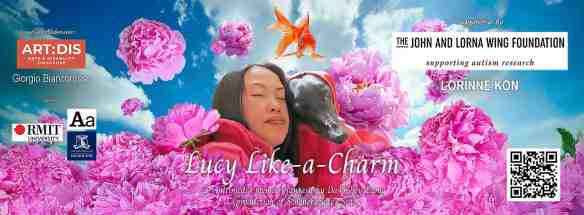
Lucy Like-a-Charm
– a multimedia, multi-access memoir-fantasy about an Autistic woman and a Greyhound dog on a magical journey towards Becoming – empowered by Love, transformed by Grace.
My thought-post today in LinkedIn. I am seldom there, because it’s not my favourite milieu, but the AI experts I mentioned are very active in LinkedIn, so I posted this there to let them know their work has impacted me. I always try to recognise people who have helped or inspired me in some way or other.
Image description in Alt Text but copied here too: White on black background, sketch of Lucy greyhound. Nose tilted downwards towards her left, eyes looking down enquiringly, her ears are relaxed but perked, ready to take on new information. She wears a blue brocade collar with a large red flower. This sketch is from a photo of Lucy taken at SYNC Sg 2019, I was sitting on the floor, exhausted in near shutdown, and she got up from her fluffy mat, and was looking at me, always caring always alert to my needs.
Sketch of Lucy Like-a-Charm – speaking without words.
I don’t know much about AI, but I became interested after hearing Wan Wei, Soh & Ammar Younas in a panel speaking passionately about AI during SIBOS2024 in Beijing. I’ve also been reading articles posted by them & Tony Fish. As an Autistic autism researcher & multimodal transdisciplinary artist focusing on alternative sentience / empathic resonance and parallel embodiments, AI fascinates me. In an early experiment at my university in Australia, more than 10 years ago, I found that I was far more comfortable alone in a room with a humanoid robot, than with a real human stranger, & the experience stayed in my mind. That comfort level was not at all close to what I enjoy when I am with amiable non-human animals, nature or the elements, but definitely better than with humans. Now, thinking about AI, and the fact that AI entities are already beginning to develop “personalities” of their own – fundamentally, if AI is ‘fed’ the right kinds of information about neurodiversity, Autistic, neurodivergent, neuroholographic states of Beingness, would it then not follow that the AI entity would be a far more comfortable, comforting & even, dare I say it, empathic companion than the average misinformed, prejudiced & discriminating ‘real’ human? And then, the question: Who therefore can be said to possess more “humanity”? The AI entity developed with the right perceptions & attitudes, or the average human holding onto erroneous & harmful notions without wanting to expand their thinking?
Regardless, I believe that the effort of studying the human state-of-being still desperately NEEDS to include wisdom gleaned from non-human animals, nature & the elements, the fundamental expansion of our narrow mindsets to consider alternative sentiences, not to be afraid of the possibilities, but to be confident that our human percipience CAN and WILL handle it all, if we are willing to embrace new understanding with respect & for the sake of the greater good, not just of humankind, but all that we are intricately intertwined together with, inside a beautiful multidimensional tapestry of Being.
I’ve been badgering research institutes & researchers to consider this trajectory for serious study, especially efficacious if from the Autistic / neuroholographic viewpoint, but to little avail. Humans are still so obsessed by navel-gazing, I fear a self-destruct moment if we do not reach outwards to learn. Some scientists (S.Simard) are already proving what many Autistics always knew, even from childhood: that trees can & do communicate meaningfully. Therefore contemplating alternative sentiences even further than that of non-human animals. But Autism research is still stuck deep inside human-centric psychology, psychiatry, sociology etc disciplines. There is a vast universe out there yet to be explored, but few want to do so. Autistics do but without agency, we cannot do much. Yet. I still hope. In my lifetime? Will AI help?
Scheherazade’s Sea 2021 was yet another groundbreaking work, at least in my country: led by a disabled artist, featuring other disabled artists, with excellent disability support professionals, and Singapore’s most experienced director in the arts and disability sector. It was a bumpy ride, to say the least. But I am ever grateful to our team for their dedication to my mission, their strength and verve, and especially to my closest ally, Director Peter Sau for his unwavering loyalty, even when things were rough and uncertain. The greatest practical challenge I faced in this project was honouring my own ethics of practising true inclusion the way I feel it ought to be practised. The grant I was awarded was a small mainstream grant, for an experimental work-in-progress, but with no additional allowance for disability support. Therefore, if I wished to provide any disability support to my cast at all, the expenses would have to be gouged out from elsewhere in the budget. I refused to ask my cast to pay out of pocket for anything as far as I could help it, unlike how other projects claiming “inclusivity” make their PWD participants contribute their time, effort and energies in exchange for “exposure” and nothing more, and so the money came from my own artist’s fee, as well as all other technical editing work. The project stretched across a year. That meant that I had to find other means to support myself. It also demanded that I single-handedly record, edit, create all the special effects, captioning, labelling, video editing and rendering etc. I had never attempted this level of technical work before, and so, completely untrained, I had to learn everything from scratch. I also had to procure a faster computer in order to do the rotoscoping effectively. There was no budget for this kind of equipment. I was working 18 hour days in the final stages of the production, despite a fragile physical condition. My medical bills hit the roof, just so I could stay alive, awake and still functioning, in order to complete the work. I owe my survival to Lucy’s constant companionship, and the strength and inspiration to keep going that she brought to the darkest nights and most frustrating moments of failure during this amazing learning adventure. Rotoscoping was the most difficult technique, which I still could not quite master, and that is quite evident in the outcome. But I remind myself that it was a monumental feat to be proud of anyway, and this was meant to be an experimental work, not a polished, slick piece of videography. This experience highlighted the lack of recognition in our arts sector for the needs of artists with disabilities. A complete disregard, in fact. But I have no regrets whatsoever, the journey in itself was worth all the excruciating pain, because of Lucy who was by my side throughout, and the wonderful humans who walked side by side all the way with me, without complaining, never losing faith and trust in me.
(Watch full video on Youtube if it cannot be played here – 31minutes)
Scheherazade’s Sea: continuing journey, 2021, was a year-long project. There were many “firsts”. Personally, I have always presented my “Scheherazade’s Sea” series as a solo artist – creator and performer. This rendition unpacks the continuing adventures of Scheherazade with a brand new approach: Scheherazade was played by the talented singer, performer Claire Teo, and joining the team were two other artists, Timothy Lee and Ariel Koh. This made Scheherazade’s Sea: continuing journey, 2021, not only disabled-led (conceptualised, executed and co-directed by me) but also a work featuring a cast of differently disabled artists at various stages of their artistic journeys.
Freelance artists around the world struggle to make ends meet. In Singapore, where the arts is even less valued by society, this struggle can sometimes be very fierce. For freelance disabled artists wanting to turn professional, and departing from the charity models, the scenario is bleak. But artists always hold on to hope, keeping our dreams alive even if by a thin thread. Since Scheherazade first appeared in 2010, my personal and professional journey has been an amazing one, at times tumultuous, but always incredibly thrilling and never boring. It is a story of survival against the odds and unexpected achievements – all of which I owe to my party of valiant human supporters and to Lucy Like-a-Charm. Upon returning to Singapore, I decided that this part of my life’s journey will be one that is actively “paying it forward” for as long as I can create art.
Scheherazade’s Sea 2021, is about newness – finding new friends and loyal supporters, and being gifted the honour and blessing of Clement Space in the form of a differently embodied creature named Lucy Like-a-Charm. In honour of all the people who have supported me so generously in a plethora of ways, I decided to now use Scheherazade’s Sea 2021 to provide practical spaces for other disabled artists in Singapore, open up mentorship and learning experiences they may not otherwise have access to without the benefit of an overseas education (which I had the privilege of enjoying). Beyond the narrative and multi-dimensional aspects of the work itself, my intentions were for this work to be a true-to-live rigorous yet safe space for professional training and experience for the cast, wherever they may be along their own paths. I could only do this, of course, with continued support from my faithful friends, my younger sister Althea, and my confrèrePeter Sau, who began my Singapore journey for me. I was inspired by Peter’s vigour and spirit in his seminal work “Project Tandem” and his role in “The Singapore ‘d’ Monologues,” and am thankful for our serendipitous meeting – because, being autistic, I have no idea how to network like neurotypical people do and so every angel in my life is to me truly a gift of providence. Thank you, Peter!
Scheherazade’s Sea 2021 is also a practice-based research into navigating the realm of the so-called ‘invisible disability’ as well as un-noticed vulnerability, and forging new strategies to artistic practice that provides access in ways that are unavailable in traditional approaches and methods.
A note on why I continue to make this work freely accessible to all on Youtube, despite having been told to keep it away from the public eye in order to pitch it to various festivals and events in Singapore and overseas. When I created Scheherazade’s Sea, way back in 2010, I meant it to be a richly textured work that everyone and anyone could easily partake of, without exclusions or arbitrary boundaries to separate people. That intent still prevails today, and even if it means no festival or big event would now want to feature this work, it is ok. The latter will be a feather in my cap and that of all the cast and crew, most definitely, but I prefer still to stay true to my raison d’être here:
I hope you enjoy the video and if you are a curator, we would, of course, love the opportunity to be featured in your festival or curated collective show if you understand my decision to make this video even more widely publicly available.
If you’d like to read my opening speech at the online premiere, please click on this link.
Video excerpts below, if you’d rather watch small, key segments instead of the long full version.
The artistic sphere is nowadays abuzz with terms like “access” and “inclusion”, with all and sundry jumping into the scene laying claim to these trendy words, but how many actually understand what they mean in practice, I wonder? No, I am not talking about the fluffy feel-good pulling-at-heartstrings stuff, or the tired and worn circus-style acts that purport to ‘include’ the disabled but are actually poorly contrived, inexpert displays of awkward disability tokenism. I am looking for concrete, meaningful and practical facilitation of access, and an inclusion that allows persons with disabilities to function from out of their individual optimal realm. Every person has the latter, regardless of what it actually is in shape, size, colour or form, we all each have our own little space, a Clement Space, in which we feel safe and from which we are allowed to emerge wholly ourselves, not broken or wanting to be fixed.
A working trip to the United Kingdom at the end of 2019 perfectly illustrated for me in real-time the essence of true, respectful, creative, meticulous and effective support – that is, dynamic access and inclusion in action.
Purchasing the bonus bundle doesn’t just give you lifetime access to every session in the summit (providing valuable understanding and support). The bonus bundle also delivers valuable extras to increase your understanding and grow your confidence.
Your Lifetime Access Bonus Bundle includes:
Lifetime access to all sessions delivered as part of the Autism Explained Online Summit Exclusive Autism Explained Online Summit Workbook Audio podcast option – listen anywhere with downloadable MP3 Downloadable interview transcripts Bonus content from each speaker 2 x follow up group coaching calls to provide additional support
I shall be chatting with Paul Micallef on 18 October about Autism-Friendly Learning Environment, how to encourage learning from within the autistic paradigm, rather than by correction and coercion to comply with neuronormative channels.
Autism Explained Online Summit is a week-long online summit featuring autistic and non-autistic professionals in the field, providing insights and advice to parents on different themes. The line-up of speakers includes Temple Grandin, Peter Vermeulen, Yenn Purkis, Daniel Giles, Andrew Whitehouse, Shadia Hancock, Wenn Lawson, Tom Tutton, Chris Varney, Emma Goodall, Jac den Houting, Chris Bonnello and many more presenting eclectic viewpoints, all in the same space!
In 2014, I took part in a study conducted by a PhD researcher who claimed to specialise in aspects of physiological and psychological empathic and social motivation in autism. I was told in advance that the study would be about emotional vs. cognitive empathy. I remember thinking that I had read a few similar studies on this same subject, but couldn’t recall the exact titles of those papers. “Replication enforces truth,” I recall the words ‘auto-writing’ on my mental blackboard, for no apparent conscious reason. The laboratory was situated in a building tucked away behind another more prominent block. Continue reading →
This study is reaching out to people who have gone through ABA (Applied Behaviour Analysis) programmes or similar, to provide actual lived-experience feedback. Open to international participants. Please email Prof Terry Cummings directly.
Please do consider joining. I understand that many of you may have PTSD associated with this and it will be very difficult and even traumatic to re-visit, but it is important that your experiences be made known. Continue reading →



 Dawn-joy Leong