My thought-post today in LinkedIn. I am seldom there, because it’s not my favourite milieu, but the AI experts I mentioned are very active in LinkedIn, so I posted this there to let them know their work has impacted me. I always try to recognise people who have helped or inspired me in some way or other.
Image description in Alt Text but copied here too: White on black background, sketch of Lucy greyhound. Nose tilted downwards towards her left, eyes looking down enquiringly, her ears are relaxed but perked, ready to take on new information. She wears a blue brocade collar with a large red flower. This sketch is from a photo of Lucy taken at SYNC Sg 2019, I was sitting on the floor, exhausted in near shutdown, and she got up from her fluffy mat, and was looking at me, always caring always alert to my needs.
Sketch of Lucy Like-a-Charm – speaking without words.
I don’t know much about AI, but I became interested after hearing Wan Wei, Soh & Ammar Younas in a panel speaking passionately about AI during SIBOS2024 in Beijing. I’ve also been reading articles posted by them & Tony Fish. As an Autistic autism researcher & multimodal transdisciplinary artist focusing on alternative sentience / empathic resonance and parallel embodiments, AI fascinates me. In an early experiment at my university in Australia, more than 10 years ago, I found that I was far more comfortable alone in a room with a humanoid robot, than with a real human stranger, & the experience stayed in my mind. That comfort level was not at all close to what I enjoy when I am with amiable non-human animals, nature or the elements, but definitely better than with humans. Now, thinking about AI, and the fact that AI entities are already beginning to develop “personalities” of their own – fundamentally, if AI is ‘fed’ the right kinds of information about neurodiversity, Autistic, neurodivergent, neuroholographic states of Beingness, would it then not follow that the AI entity would be a far more comfortable, comforting & even, dare I say it, empathic companion than the average misinformed, prejudiced & discriminating ‘real’ human? And then, the question: Who therefore can be said to possess more “humanity”? The AI entity developed with the right perceptions & attitudes, or the average human holding onto erroneous & harmful notions without wanting to expand their thinking?
Regardless, I believe that the effort of studying the human state-of-being still desperately NEEDS to include wisdom gleaned from non-human animals, nature & the elements, the fundamental expansion of our narrow mindsets to consider alternative sentiences, not to be afraid of the possibilities, but to be confident that our human percipience CAN and WILL handle it all, if we are willing to embrace new understanding with respect & for the sake of the greater good, not just of humankind, but all that we are intricately intertwined together with, inside a beautiful multidimensional tapestry of Being.
I’ve been badgering research institutes & researchers to consider this trajectory for serious study, especially efficacious if from the Autistic / neuroholographic viewpoint, but to little avail. Humans are still so obsessed by navel-gazing, I fear a self-destruct moment if we do not reach outwards to learn. Some scientists (S.Simard) are already proving what many Autistics always knew, even from childhood: that trees can & do communicate meaningfully. Therefore contemplating alternative sentiences even further than that of non-human animals. But Autism research is still stuck deep inside human-centric psychology, psychiatry, sociology etc disciplines. There is a vast universe out there yet to be explored, but few want to do so. Autistics do but without agency, we cannot do much. Yet. I still hope. In my lifetime? Will AI help?
Author’s note: This piece took me awhile to complete, because I have been struggling with the devastating aftermath of Lucy’s death on my mind, body and every part of my existence. I was invited some time ago to write a reflection for a blog-journal, but upon submitting it on 4th July 2023 at 14:22 Singapore time, I was told by the editor (in the UK) that they will push back my article to end July, because the editor was too busy with other things. Coincidentally, they have just published another piece expressing almost identical thoughts, though written in a completely different style, of course. I am fine with that. The more people asking the same questions, the louder our voices become.
I have therefore decided to put mine here, unedited, with date and time reflecting the exact moment my piece was submitted via cyber-waves into the Great Unknown. Whether or not the journal’s editor decides to publish it in the near future, when and with what edits they deem fit, is immaterial to me. The Artist respects the autonomous entity of The Work, which will forge onwards along its own inexorable path, free from the tyranny of control and manipulation at the hands of humans preoccupied by and with human-centric glorification and maniacal demands of human ego. After some deeper contemplation, I feel that The Work, in this embodiment, is telling me that it would like to be launched from this Clement Space, an interstice created for me, for us both, by Lucy, because it is in its very purest essence an intimate tribute to Lucy, and to her and only her, do I really owe anything at all. When the Artist frees The Work, the Artist shall also be emancipated. I love you so, Lucy Like-a-Charm, thank you for teaching me such profound sensing.
Content warning: suicide and death is discussed in this article.
I always enjoy working with veteran director and theatre maestro Peter Sau, probably the only director in Singapore that I love working with, because he understands my artistic/creative foci and my needs arising from my disabilities.
Here’s a video clip of my performance at the Singapore Writers Festival 2022 presented by ART:DIS, directed by Peter Sau. Small bits of it have been edited out, but it’s mostly intact. Watch it on ART:DIS’ Instagram page. The beautiful soundscape is by the talented Niran Jierapipatanakul, intern at ART:DIS.
For those Deaf/deaf and hard of hearing, or those unable to make out the spoken word because of the echo in the soundtrack, here is the script. For the blind/visually impaired, the sharp sounds you hear intermittently are made by my placards of key words falling to the ground.
Scheherazade’s Sea 2021 was yet another groundbreaking work, at least in my country: led by a disabled artist, featuring other disabled artists, with excellent disability support professionals, and Singapore’s most experienced director in the arts and disability sector. It was a bumpy ride, to say the least. But I am ever grateful to our team for their dedication to my mission, their strength and verve, and especially to my closest ally, Director Peter Sau for his unwavering loyalty, even when things were rough and uncertain. The greatest practical challenge I faced in this project was honouring my own ethics of practising true inclusion the way I feel it ought to be practised. The grant I was awarded was a small mainstream grant, for an experimental work-in-progress, but with no additional allowance for disability support. Therefore, if I wished to provide any disability support to my cast at all, the expenses would have to be gouged out from elsewhere in the budget. I refused to ask my cast to pay out of pocket for anything as far as I could help it, unlike how other projects claiming “inclusivity” make their PWD participants contribute their time, effort and energies in exchange for “exposure” and nothing more, and so the money came from my own artist’s fee, as well as all other technical editing work. The project stretched across a year. That meant that I had to find other means to support myself. It also demanded that I single-handedly record, edit, create all the special effects, captioning, labelling, video editing and rendering etc. I had never attempted this level of technical work before, and so, completely untrained, I had to learn everything from scratch. I also had to procure a faster computer in order to do the rotoscoping effectively. There was no budget for this kind of equipment. I was working 18 hour days in the final stages of the production, despite a fragile physical condition. My medical bills hit the roof, just so I could stay alive, awake and still functioning, in order to complete the work. I owe my survival to Lucy’s constant companionship, and the strength and inspiration to keep going that she brought to the darkest nights and most frustrating moments of failure during this amazing learning adventure. Rotoscoping was the most difficult technique, which I still could not quite master, and that is quite evident in the outcome. But I remind myself that it was a monumental feat to be proud of anyway, and this was meant to be an experimental work, not a polished, slick piece of videography. This experience highlighted the lack of recognition in our arts sector for the needs of artists with disabilities. A complete disregard, in fact. But I have no regrets whatsoever, the journey in itself was worth all the excruciating pain, because of Lucy who was by my side throughout, and the wonderful humans who walked side by side all the way with me, without complaining, never losing faith and trust in me.
(Watch full video on Youtube if it cannot be played here – 31minutes)
Scheherazade’s Sea: continuing journey, 2021, was a year-long project. There were many “firsts”. Personally, I have always presented my “Scheherazade’s Sea” series as a solo artist – creator and performer. This rendition unpacks the continuing adventures of Scheherazade with a brand new approach: Scheherazade was played by the talented singer, performer Claire Teo, and joining the team were two other artists, Timothy Lee and Ariel Koh. This made Scheherazade’s Sea: continuing journey, 2021, not only disabled-led (conceptualised, executed and co-directed by me) but also a work featuring a cast of differently disabled artists at various stages of their artistic journeys.
Freelance artists around the world struggle to make ends meet. In Singapore, where the arts is even less valued by society, this struggle can sometimes be very fierce. For freelance disabled artists wanting to turn professional, and departing from the charity models, the scenario is bleak. But artists always hold on to hope, keeping our dreams alive even if by a thin thread. Since Scheherazade first appeared in 2010, my personal and professional journey has been an amazing one, at times tumultuous, but always incredibly thrilling and never boring. It is a story of survival against the odds and unexpected achievements – all of which I owe to my party of valiant human supporters and to Lucy Like-a-Charm. Upon returning to Singapore, I decided that this part of my life’s journey will be one that is actively “paying it forward” for as long as I can create art.
Scheherazade’s Sea 2021, is about newness – finding new friends and loyal supporters, and being gifted the honour and blessing of Clement Space in the form of a differently embodied creature named Lucy Like-a-Charm. In honour of all the people who have supported me so generously in a plethora of ways, I decided to now use Scheherazade’s Sea 2021 to provide practical spaces for other disabled artists in Singapore, open up mentorship and learning experiences they may not otherwise have access to without the benefit of an overseas education (which I had the privilege of enjoying). Beyond the narrative and multi-dimensional aspects of the work itself, my intentions were for this work to be a true-to-live rigorous yet safe space for professional training and experience for the cast, wherever they may be along their own paths. I could only do this, of course, with continued support from my faithful friends, my younger sister Althea, and my confrèrePeter Sau, who began my Singapore journey for me. I was inspired by Peter’s vigour and spirit in his seminal work “Project Tandem” and his role in “The Singapore ‘d’ Monologues,” and am thankful for our serendipitous meeting – because, being autistic, I have no idea how to network like neurotypical people do and so every angel in my life is to me truly a gift of providence. Thank you, Peter!
Scheherazade’s Sea 2021 is also a practice-based research into navigating the realm of the so-called ‘invisible disability’ as well as un-noticed vulnerability, and forging new strategies to artistic practice that provides access in ways that are unavailable in traditional approaches and methods.
A note on why I continue to make this work freely accessible to all on Youtube, despite having been told to keep it away from the public eye in order to pitch it to various festivals and events in Singapore and overseas. When I created Scheherazade’s Sea, way back in 2010, I meant it to be a richly textured work that everyone and anyone could easily partake of, without exclusions or arbitrary boundaries to separate people. That intent still prevails today, and even if it means no festival or big event would now want to feature this work, it is ok. The latter will be a feather in my cap and that of all the cast and crew, most definitely, but I prefer still to stay true to my raison d’être here:
I hope you enjoy the video and if you are a curator, we would, of course, love the opportunity to be featured in your festival or curated collective show if you understand my decision to make this video even more widely publicly available.
If you’d like to read my opening speech at the online premiere, please click on this link.
Video excerpts below, if you’d rather watch small, key segments instead of the long full version.
Sonia has an amazing way with words. It doesn’t need to be a lengthy piece, in fact, her words are so lithe and fluid, yet exquisitely penetrating and precise, that I am left catching my breath at the sharp, deft unlocking of a wealth of unspoken, unworded meaning. And, in an uncanny way, each and every time I am incapable of bringing into the tangible realm what I wish to express, somehow, Sonia’s words will give strong yet delicate voice to the rhythmic humming resonating in my being.
“How rare it is to see people with complex needs just being. Humming is natural, and nothing is dressed-up; this isn’t ‘special needs’ for consumption. There’s no attempt to exoticise or glamorise our being. The camera captures ordinary moments valuing autistic language and expression on our terms.”
This is exactly what first hit me right there at my core, when I first watched the film. It unpacks our meanings, our world, on our terms.
Actually, I watched it three times, each time catching different details and sensory echoes. In fact, I’ve also run it over and over again in the background, allowing different aspects of it to weave in and out of my consciousness, meandering and winding around caverns of sensory subconscious as I engage in different light tasks. I love the clattering sounds, the staccato, the ripples, the appoggiatura and trills, the sudden drop in levels, the pitter patter of rain like crisps dancing inside a foil coated box…
And then, Sonia says this:
“It suddenly strikes me that this film feels like home to me because this is where I began. There’s a circularity in writing this piece for Project Art Works, which underlines its immense importance as an artwork. As a young art therapist, I was employed in a residential setting for adults with complex needs; not knowing that I was myself autistic until very many years later. Since then, I’ve come to recognise aspects of myself in those with more complex needs than my own, but as a younger person I had no way of understanding why I was so drawn to this world. Years of my life have been wasted and lost.”
Wasted and lost! Wasted AND lost! WASTED and lost! Wasted and LOST! These words sound like bells, whose echoes and reverberations fill my chest cavity, pounding against my rib cage. I think of the bells inside Magdelen College Tower on the first of May.
Everything is there, embedded in Sonia’s three words. This world that is so simply presented in the film, a realm so full, so abundant with wonderment.
When I first read Searle’s review, pronouncing it “problematic” without any further explanation, a searing hot rage shot through my core. I was shaking with fury, yet hurt, it brought back horrific wound trauma, I know that kind of dismissal too well, flicking away the rich tapestry of my multi-textured world like crumbs off a table, that neuronormative gesture of disdain so ponderous, so callous, so crude in its garish ignorance.
But then, after the film had played umpteen times like a comforting echo in my senses, I now feel sad. Sad for Searle and those like him, who are unable to access and luxuriate in our world, who stand outside and sweep at crumbs on neuronormative cafe tables, never noticing the flow, the undulating rhythm, the shuddering patterns, and the tiny clicking, chirping sounds the specks make as they fall, fall, fall to the groaning, giggling ground. A tragedy, to me, not to be able to resonate with the richness that is our multidimensional universe. This is the true loss. Yet, do they know of this loss?
Sonia’s words again, in her other article responding to Searle’s review:
“This film speaks to me in my language. This is mysensory world. For me, Illuminating the Wilderness is a rare and beautiful thing, and I feel sorry for those who can’t see it. Our immersive connection to the sensory world can feel vast and expansive – it is beyond words. This is supremely exciting to us, and joyfully fulfilling. It’s why we don’t need to people so much – we have this!”
Yes, we do indeed, and what a wonderful world it is!
This morning, the Birthday Book 2020 arrived. Even though I don’t get a single cent of royalties from this book, I am glad to have had the opportunity to contribute to this collection, and I chose a topic that is important to me: disability. I’m allowed to share my own essay in my networks, and so here it is.
Seeing Singapore Clearly through the Eyes of Disability – Dawn-joy Leong First published in The Birthday Book 20/20: Seeing Clearly edited by Selina Chong and Chua Jun Yan (Singapore: The Birthday Collective, 2020).
I was born in the year of Singapore’s independence. My childhood memories were filtered through the lenses of my immediate world. To me, Singapore was a small, brave country with a firm but capable government dedicated to creating better lives for citizens.
My parents had friends from diverse backgrounds and I was taught to embrace diversity. Father, a dental surgeon, often saw patients who could not afford to pay for treatment. Out of gratitude, they brought him whatever they had: home- baked cakes and food, eggs from their kampung chickens and even the occasional live fowl. Mother was a teacher, and she used to give extra lessons to students who were floundering and unable to afford private tuition. I remember mother bringing me along during some of her home visits, armed with books, stationery and food for the students and their families.
I lived a life of relative privilege, but my parents inculcated in me a sense of civic duty. They taught me to view everyone with compassion and respect. I also firmly believed in our National Pledge’s commitment to “justice and equality”. Despite being labeled as “eccentric”, I enjoyed a healthy social life, and employment was not an issue. Unaffected by discrimination or injustice, I naively believed there wasn’t any in Singapore.
Then I found out at the age of forty-two, while pursuing an M.Phil in music composition at the University of Hong Kong, that I am Autistic. After Hong Kong, I received a Ph.D scholarship at the University of New South Wales, Australia. I openly and proudly identified as Autistic, using the Identity-First language preferred by most Autistic people globally. I acquired a psychiatric assistance dog, Lucy, for my sensory anxiety, with the legal right to have her with me everywhere I went. I helped to found an Autism Research Group comprising autistic and non-autistic members across different disciplines. I was awarded my school’s “Dean’s Award for Excellence in Research”, an accolade given to one top PhD candidate per year.
It was only upon returning to Singapore, proudly identifying as Autistic, that my erstwhile gentle and salubrious world cracked open to a harsh reality. In late 2016, Lucy and I made an exciting journey to Singapore, traveling in-cabin together for the first time. My elation quickly fizzled away when I stepped out of Changi and found that Lucy was not welcome in most places. Assistance dogs for the disabled have existed for many decades, yet most Singaporeans – including those who work in the field of disability – had never heard of them, apart from Guide Dogs for the blind.
The stability of full-time employment eluded me. Non-disabled people claiming to be disability experts corrected me in my use of self-identifying terminology, as if they knew better. When I asked for an honorarium to speak at events, I was told variously that I should be grateful for the “exposure”, or that I should work for the benefit of my “own community”, or that experienced artists should give talks without payment to”‘inspire” young people.
Strangely enough, these people were paid to do their jobs in whatever enterprise they represented. Here was my reply: I did engage in volunteer work. For example, I was and am a Board Member of the Disabled People’s Association. But it is my right – and not someone else’s – to decide to whom I offer my time, energy and expertise. Disabled people have higher bills to pay just to exist. How are we to do so if all we ever did was volunteer work?
Where are the voices of those who are actually disabled in this cacophony of “awareness” and “inclusion”? Disabled leadership is not about exclusive power or taking away jobs from the non-disabled, but rather having a dignified place at the table where our voices – personal and professional – may be valued alongside our non-disabled peers.
My story does not end in tragedy and hopelessness. After two years of knocking repeatedly at the nebulous “glass ceiling”, I decided that the way forward was self-employment. I met disabled and non-disabled people who were sincere and committed to the goal of equity and progress and unafraid to step into uncharted ground. These included university professors, young researchers, representatives of organisations, and people with diverse disabilities joining together to widen horizons beyond old models of charity.
In 2019, I co-founded the Disabled Artists’ Collective, a pan-disability group of freelance artists. I began collaborating with theatre producer-director Peter Sau, a pioneer in theatre practice with disabled artists. I helmed Singapore’s first disabled-led artist residency at library@orchard, featuring three neurodivergent artists from the Disabled Artists’ Collective. In June, I was one of two Autistic Plenary Speakers at the Asia Pacific Autism Conference 2019, marking the first time actual Autistic persons were represented prominently in a major autism event in Singapore.
In 2020, six members of the Disabled Artists’ Collective performed in a groundbreaking promenade theatre show, “Something About Home”. It was Singapore’s first fully accessible and inclusive mainstream professional production featuring disabled artists, but not limited to the arts and disability platform. The National Gallery also commissioned my work, Clement Space, a calm room based on my research in Autism, designed from within the Autistic paradigm.
As a disabled person, I see Singapore more clearly now than ever before. Insecurity, ignorance and exploitation prevail, but there is also sincere intent, commitment, and vast potential. I wish for a Singapore where the disabled and non-disabled have equal rights to stand together as “one united nation, based on justice and equality”.
Here is my raison d’être:
“It is not my purpose to ‘fix’ what is ‘broken’, but to empower beauty in the vulnerable and unseen.” Scheherazade’s Sea, 2010.
To order the book, please head to the Birthday Collective’s website. They’re offering a 10% discount for pre-launch orders (online launch happening 22 August this Saturday!). ** I don’t earn a single cent of royalties but do please support this good work!
Autistic focus is sometimes looked upon as social impairment, but it is a quality that has, throughout human history, lifted up and pushed forward human progress. I’m still chewing over this topic… maybe someday more researchers will rise up and provide clarity to this important trajectory. For now, I contribute in my small way by persevering.
This article was brought to my attention by an Autistic friend last night. The title sounded most promising: “Meet the autistic scientists redefining autism research”. However, I was disappointed to find the narrow, prejudiced focus and disrespectful, superficial treatment of the subject matter. If the author’s purpose was to amplify and highlight Autistic researchers studying autism in a positive way, they have failed to include a number of prominent Autistic autism researchers in the piece, and this exclusion indicates either a lack of thorough understanding of the subject matter or a deliberate choice of bias, or perhaps a combination of both.
Before I continue, I would like to make clear that this is a blog post, not an academic paper, thus I am writing in direct and pressingly immediate response to an article that has caused me some considerable mental trauma such that I have been unable to sleep all night. Nevertheless, I am also an Autism Researcher, part of the “community” mentioned in the article of actual Autistic researchers investigating autism from multiple perspectives, and I personally know a few of the researchers mentioned in this article, whose work I regard highly.
Autistic minds perceive and respond to the world in markedly different ways from the neuronormative, and even often from the neurodivergent non-autistic. In many cases, the ways in which autistics process and react to information and stimuli add unique multidimensionality to research, discovery and invention in all fields of study and practice.
The article completely misses the point of the richness of Autistic contribution to autism research, by opening with just one autistic researcher’s alleged reaction to the “great apes” and quoting that researcher, Monique Botha, as saying such associations are “nauseating”, thus insinuating that this has added to the mental health problems of autistic people. (I suspect poor journalism to be at fault here, from my experience of being misquoted by many a sloppy journalist). There was also derisive mention of robots, without in-depth consideration of the topic. The sweeping statement, describing the associations between the study of animals, robots and autism as “ugly parallels to apes and robots”, reflects a pathetic lack of knowledge about the actual work of Autistic researchers in these areas, which is saddening at best in an article dedicated to promoting Autistic researchers, and at worst adding to the mental health burdens of Autistic people by further stigmatising the eclecticism of the Autistic realm.
Here is what Dr. Dawn Prince-Hughes, respected Autistic primatologist, ethologist and anthropologist wrote in the comments section of this article:
I am the autistic researcher who, after years of rejection by neurotypicals, found myself under the connecting tutelage of captive gorillas and used my experiences with them to revolutionize how we see the Spectrum. As I have made clear in all my groundbreaking writings, it is speciesist to imply that the apes who taught me to be social — who have indeed helped my spectrum people in this way — are an insult to be compared to. If there is indeed no shame in being neurodivergent then we should appraise animals under a neurodivergent rubric rather than recoiling at their differences. Your attitude shows that such prejudice is alive and well….and ugly…despite the surface assertions of your article.
The following is my own response to the article, made nine hours ago, a time when I should have been tucking my beloved Lucy into bed (she did bark to tell me it was time for our bedtime ritual, but I was too busy typing out my comment because I was so distressed by this article that my unreliable humanity failed Lucy yet once again).
I am Autistic, I am also an autism and neurodiversity researcher, as well as a multi-art practitioner. I quoted Dawn Prince-Hughes work extensively in my PhD: “Scheherazade’s Sea – autism, parallel embodiment and elemental empathy” (2016). My research focuses on alternative empathic connectivity intrinsic in the autism paradigm. Prince-Hughes’ work has been pivotal to my research into a non-worded, acutely sensorial empathic resonance with the material universe that many (though obviously not all) Autistic people possess. I, like Prince-Hughes, have learned a great deal about my own humanity as an Autistic human – strengths and failings, rhythms and patterns of perceptivity, richness of sensorial interrelatedness – from observing non-human species. Humans have a great deal to learn from the ones they despise and feel superior to, mostly from imbalanced and uninformed assumptions. Neurotypicals view autistics as inferior because our communicative rhythms and patterns differ from the normative – are we not applying the same kind of biases towards animals when we say it is nauseating to be compared with them? Prince-Hughes’ work is groundbreaking, there is not disrespect for the human nor the non-human, her treatment of the subject and her insights could only have been achieved by a penetratingly sensitive Autistic mind. The author of this article has failed miserably to find this precious connection that many Autistic researchers – like Prince-Hughes and myself – have spoken about. As Prince-Hughes articulated in her comment, such thinking is not only speciesist but ignorant of the multidimensionality of Autistic researchers study in autism. The realm of Autism is a complex and beautiful one, and should be studied and respected from more than just the obsessively human-centric viewpoint. I, for one, am not ashamed to learn from non-speaking humans and non-speaking non-humans. I don’t study the great apes, but my research in Autism has found much inspiration from studying canine communication. Indeed, I agree with Dawn Prince-Hughes: “we should appraise animals under a neurodivergent rubric rather than recoiling at their differences”!
Apart from obviously not having read the groundbreaking work of Dr. Prince-Hughes, (and my own more humble PhD dissertation), the author of the article presents a view that is heavily biased and obsessively human-centric, ironically in so doing contributing to the stigmatisation of Autistic people that the author claims to be trying to dispel. Does the author even know that there are now many young Autistic researchers studying autism in relation to animals and the elemental empathic interconnectivity? This article has, in a few ill-chosen words, made a mockery of the valuable trajectories being explored by these Autistic brilliant minds.
Instead of viewing animals and robots as “nauseating” insults to our humanity, why not see them as potentially powerful channels or windows into richer tapestries of learning, discovery and connectivity? Is our human-centric world the only sentient one (we know by now that it is not), or perhaps the only important one (again, anyone with any knowledge of current animal science would know that it is not)? Of course, I am incensed when non-autistic ‘experts’ lump autistics together with animals, because their assertions lack any deep and thorough understanding of the autistic paradigm and that of animals. Of course, I am traumatised when non-autistic ‘experts’ try to use robots to teach autistic children about normative social skills (not autistic social skills, mind you, because we do indeed have our own social system) because these ‘experts’ lack empathic understanding of both autism and robotics. When one is face to face with disrespectful lack of true expertise wanting to dominate one’s own domain, of course, one’s reaction is that of vigorous and vehement rejection!
My issue with the animal-Autistic or robot-Autistic comparisons lies firmly in the ways in which these are made and presented – by non-Autistics. If the subject matter was researched and interpreted by Autistic researchers, the fundamental premises and approaches would be completely different. Based on what we already know about the ways in which Autistic brains perceive, process and respond to information, it is perfectly logical to expect that the Autistic researcher, if their passion was to study animals or robots, would have insights and draw associations that differ from the normative view. This is apparent in the groundbreaking work of Autistic animal behaviour specialists, Temple Grandin and Dawn Prince-Hughes. While I disagree with much of Temple Grandin’s outdated views of autism, her oft-quoted phrase rings true and clear to me: “Animals make us human.” (Bear in mind that although Grandin opened the doors to autistic representation, she nevertheless belongs to a different time and era, and her views have understandably been surpassed in the area of autism research and understanding.) Dawn Prince-Hughes’ work with gorillas is much richer and multi-textured, with a lot more sensitivity and tenderness than Grandin’s interpretation of cattle and horses. In fact, Prince-Hughes’ book, “Songs of the Gorilla Nation” is one of the most beautiful, empathic and resonant scientific discourses I have ever read. I have drawn from both Grandin and Prince-Hughes for my own study, and much of my PhD dissertation about autism, parallel embodiment and elemental empathy was inspired by my own connection with Lucy, my Greyhound. The more I observed Lucy and her interaction with me and the world, the more I became interested in studying canine communication, and the more I found resonance in my own Autistic realm. When I refer to Lucy as my muse, it is not from the feel-good anthropomorphic impulse so common in neuronormative ‘pet lovers’, but I use that description factually and literally, she is my source of scientific and artistic inspiration. I have learned far more about myself, my Autistic domain, and my humanity from Lucy than I have from any other human.
As for robots, although robotics is not my area of expertise by far, I am nevertheless fascinated by them, and I have no objections at all about using robots as one of the many ways in which to learn. I once took part in an experiment where I was alone in a strange room with a female robot (the Geminoid F) that I had never met before. Strange room, strange robot. I remember feeling far more at ease in the company of the robot than when I had to socialise with all the other strange humans taking part in the same experiment. Most others’ reactions were the opposite of mine. They described their experiences as “surreal” and “creepy”. I believe that if Autistic researchers were leading studies into the robot-Autistic connection, using robots as a conduit to learning, an entirely different space would be opened up for energetic discourse and discovery.
Once again, yet another human-obsessed, poorly researched article sadly lacking in empathic resonance has succeeded in adding to the trauma of Autistic people, despite claiming todo otherwise. Such a wasted opportunity. Perhaps Spectrum should pay someone like myself to write better features if Spectrum is truly interested in advancing the cause of Autistics. You see, Autistic people are human, and humanity is eclectic in the ways in which we exist. Is the human mind so small, so restricted and lacking in creative imagination that it can only understand and be uplifted by that which exists in the human realm alone? Is it not time that we look deeper, wider, higher and embrace differences – all differences – with the wonderment and respect that it deserves? Our human world is in a great deal of trouble and subjected to pernicious destruction because humans have for far too long – in all of human history, actually – focused far too overtly on our own existence to the exclusion and detriment of everything else on this earth. If we truly wish to heal the ills that we have wrought, we need to stop navel-gazing and begin to embrace what is outside of our tiny little domains.
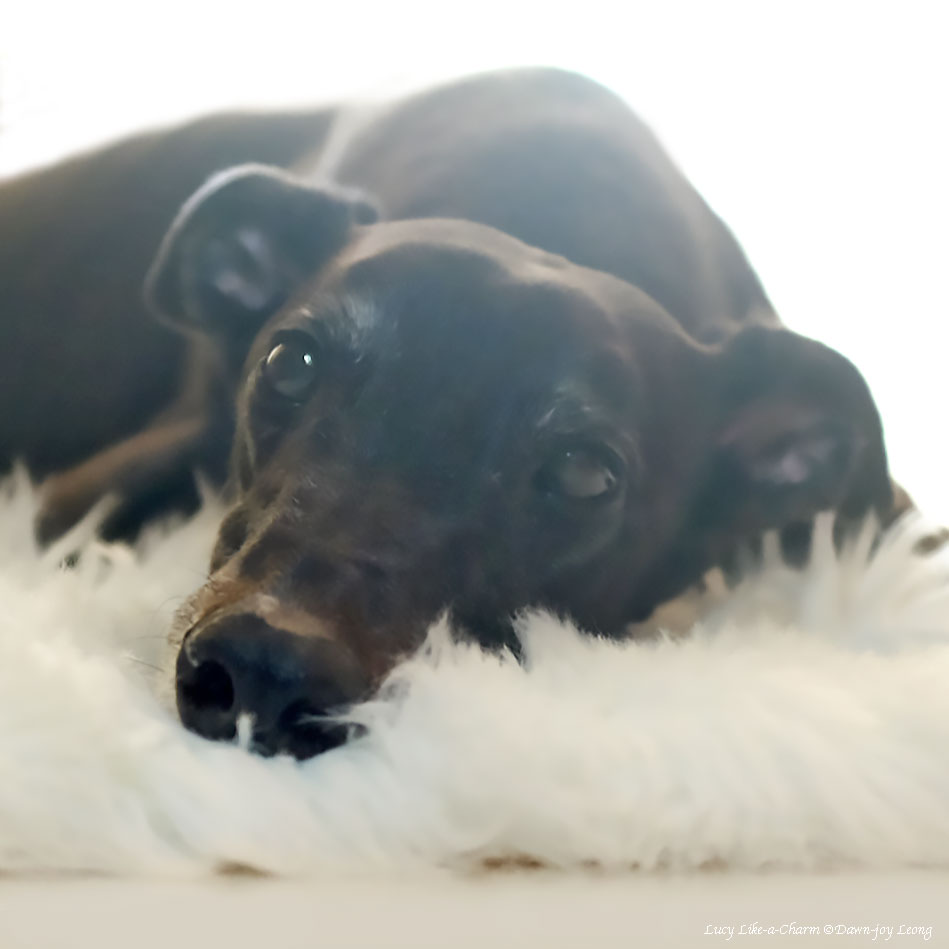
Look into this face and tell me you see nothing worthy of associating with? Shame on you, if so.
Postscript 15 June 2020: The conversation is ongoing, which is healthy and I hope will provide new angles and trajectories to follow.
Monique Botha has written a lengthy response, so please check it out (beneath the article itself).
As I quite clearly said in my blog post: I, too, take umbrage at the way (mostly non-autistic) ‘experts’ use animals and robots as comparisons etc with Autistics, my reason is, like you, these comparisons emerge from an offensively erroneous perspective. However, researchers – autistic and non-autistic alike – need to be openminded enough to explore these connections, from the Autistic paradigm. Dawn Prince-Hughes’ work, and mine too, present powerful and valid angles which are important to autism studies, and there is a wealth of richness to be gleaned from here. In fact, if one is properly apprised of such Autistic driven work, one would discover that our Autistic driven research present cogent challenges to the other kinds of animal / robot research that we abhor. It is not as constructive to only present what is wrong with the approaches to one subject, as if one were to point out what is wrong plus present what is right, as a solution to the wrong. The problem with (mostly non-autistic) perspectives is – as you may already have been made aware of via the current article’s poor research and poor journalism – pursuing one thread without insisting on a multi-dimensional context, a lot of harmful misinformation and misunderstanding is propagated. Again, in the case of this article, the author has failed to do their homework. In fact, if you read Michelle Dawson’s Twitter comment on this article, you would find that it has not only upset Dawn Prince-Hughes and myself.
On an aside, I look forward to reading more of you(r) work, and perhaps you might have already added this other dimension to it, which I am unaware of.
THIS is why Nothing About Us Without Us is so crucial. Whether autistic or not, when presenting information, one needs to engage in thorough research from as many angles as are available. Of course I don’t wish to be compared in a derogatory way with anything at all – humans, animals or robots alike. However, because I know what I know, I would also qualify that with the kind of research that makes such comparisons from a respectful and even beautifully accurate and cogent perspective. Good research cannot make one assertion based on one dimension of the topic alone, it should thoroughly inspect and include other dimensions. In this case, yes, it is a travesty to be comparing Autistics in an insulting way with animals and robots. But researchers – whether autistic or not – addressing this problem should thus also present the ways in which these connections are being made with penetrating and groundbreaking insights that respectfully present new dimensions to the topic, and also emphasises the need for actual Autistic researchers in the field of autism study. The latter are cogent solutions and answers to the former conundrum. Why are researchers not even exploring or acknowledging this? Too much intense focus on humans alone may not be the answer to our human problems. Autistic people live in a wonderfully multi textured world. We should learn to discover this. Human-centricity, human navel gazing, will not solve humanity’s problems – as we can see from thousands of years of human history.
I love the quietude of what people are calling “self-isolation” and “distancing”. I am one of those autists who delight in inhabiting my own little bubble of presence. Yet, I am unable to quell the force majeure of interconnectivity, and what my mind intuits and decodes is quietly shattering the gentleness of solitude.
My Autistic Brain, yes, blame that brain. All those little details, patterns, rhythmic sequences unfolding, unpacking and evolving. The minuscule bits and bobs that reach out with mournful tendrils, grasp, touch and intertwine across a massive expansive network of misery, fear, anxiety and pain. The final few seconds of gasping, life slipping away, the excruciating knowing. The gnashing and grinding of teeth as vicious evil commodifies lives, directing the theatrical tragedy from their self-established positions in the stratosphere, while commonplace humanity groans. Every little ornament – dust particles of affliction, microscopic droplets of misery – screams in shattering silence. The turmoil is palpable, overwhelming and crushing – all the frantically gyrating, jostling dots are concatenated in dolorous bitter chains.
It isn’t only sensory inundation that leads to meltdown. It’s also cognitive deluge that threatens shutdown.



 Dawn-joy Leong