This morning, the Birthday Book 2020 arrived. Even though I don’t get a single cent of royalties from this book, I am glad to have had the opportunity to contribute to this collection, and I chose a topic that is important to me: disability. I’m allowed to share my own essay in my networks, and so here it is.
Seeing Singapore Clearly through the Eyes of Disability – Dawn-joy Leong
First published in The Birthday Book 20/20: Seeing Clearly edited by Selina Chong and Chua Jun Yan (Singapore: The Birthday Collective, 2020).
I was born in the year of Singapore’s independence. My childhood memories were filtered through the lenses of my immediate world. To me, Singapore was a small, brave country with a firm but capable government dedicated to creating better lives for citizens.
My parents had friends from diverse backgrounds and I was taught to embrace diversity. Father, a dental surgeon, often saw patients who could not afford to pay for treatment. Out of gratitude, they brought him whatever they had: home- baked cakes and food, eggs from their kampung chickens and even the occasional live fowl. Mother was a teacher, and she used to give extra lessons to students who were floundering and unable to afford private tuition. I remember mother bringing me along during some of her home visits, armed with books, stationery and food for the students and their families.
I lived a life of relative privilege, but my parents inculcated in me a sense of civic duty. They taught me to view everyone with compassion and respect. I also firmly believed in our National Pledge’s commitment to “justice and equality”. Despite being labeled as “eccentric”, I enjoyed a healthy social life, and employment was not an issue. Unaffected by discrimination or injustice, I naively believed there wasn’t any in Singapore.
Then I found out at the age of forty-two, while pursuing an M.Phil in music composition at the University of Hong Kong, that I am Autistic. After Hong Kong, I received a Ph.D scholarship at the University of New South Wales, Australia. I openly and proudly identified as Autistic, using the Identity-First language preferred by most Autistic people globally. I acquired a psychiatric assistance dog, Lucy, for my sensory anxiety, with the legal right to have her with me everywhere I went. I helped to found an Autism Research Group comprising autistic and non-autistic members across different disciplines. I was awarded my school’s “Dean’s Award for Excellence in Research”, an accolade given to one top PhD candidate per year.
It was only upon returning to Singapore, proudly identifying as Autistic, that my erstwhile gentle and salubrious world cracked open to a harsh reality. In late 2016, Lucy and I made an exciting journey to Singapore, traveling in-cabin together for the first time. My elation quickly fizzled away when I stepped out of Changi and found that Lucy was not welcome in most places. Assistance dogs for the disabled have existed for many decades, yet most Singaporeans – including those who work in the field of disability – had never heard of them, apart from Guide Dogs for the blind.
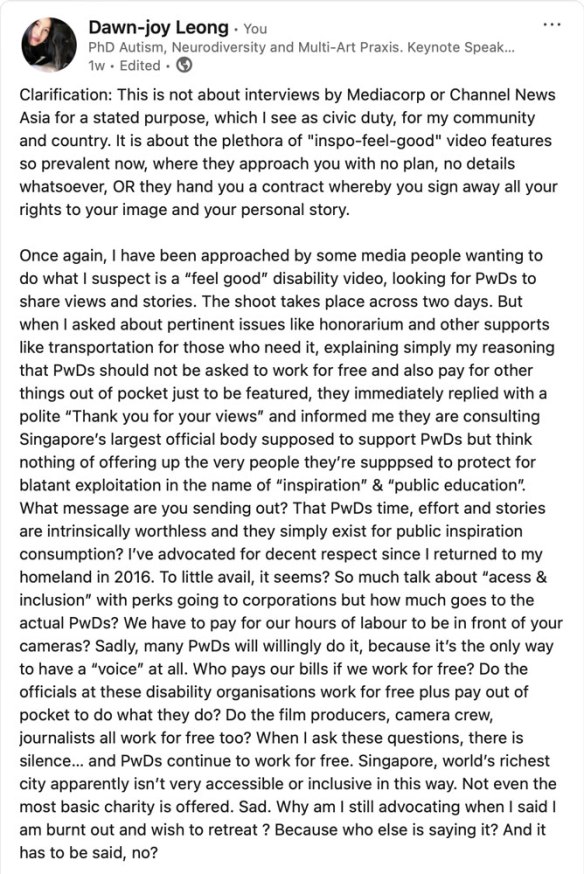
The stability of full-time employment eluded me. Non-disabled people claiming to be disability experts corrected me in my use of self-identifying terminology, as if they knew better. When I asked for an honorarium to speak at events, I was told variously that I should be grateful for the “exposure”, or that I should work for the benefit of my “own community”, or that experienced artists should give talks without payment to”‘inspire” young people.
Strangely enough, these people were paid to do their jobs in whatever enterprise they represented. Here was my reply: I did engage in volunteer work. For example, I was and am a Board Member of the Disabled People’s Association. But it is my right – and not someone else’s – to decide to whom I offer my time, energy and expertise. Disabled people have higher bills to pay just to exist. How are we to do so if all we ever did was volunteer work?
Where are the voices of those who are actually disabled in this cacophony of “awareness” and “inclusion”? Disabled leadership is not about exclusive power or taking away jobs from the non-disabled, but rather having a dignified place at the table where our voices – personal and professional – may be valued alongside our non-disabled peers.
My story does not end in tragedy and hopelessness. After two years of knocking repeatedly at the nebulous “glass ceiling”, I decided that the way forward was self-employment. I met disabled and non-disabled people who were sincere and committed to the goal of equity and progress and unafraid to step into uncharted ground. These included university professors, young researchers, representatives of organisations, and people with diverse disabilities joining together to widen horizons beyond old models of charity.
In 2019, I co-founded the Disabled Artists’ Collective, a pan-disability group of freelance artists. I began collaborating with theatre producer-director Peter Sau, a pioneer in theatre practice with disabled artists. I helmed Singapore’s first disabled-led artist residency at library@orchard, featuring three neurodivergent artists from the Disabled Artists’ Collective. In June, I was one of two Autistic Plenary Speakers at the Asia Pacific Autism Conference 2019, marking the first time actual Autistic persons were represented prominently in a major autism event in Singapore.
In 2020, six members of the Disabled Artists’ Collective performed in a groundbreaking promenade theatre show, “Something About Home”. It was Singapore’s first fully accessible and inclusive mainstream professional production featuring disabled artists, but not limited to the arts and disability platform. The National Gallery also commissioned my work, Clement Space, a calm room based on my research in Autism, designed from within the Autistic paradigm.
As a disabled person, I see Singapore more clearly now than ever before. Insecurity, ignorance and exploitation prevail, but there is also sincere intent, commitment, and
vast potential. I wish for a Singapore where the disabled and non-disabled have equal rights to stand together as “one united nation, based on justice and equality”.
Here is my raison d’être:
“It is not my purpose to ‘fix’ what is ‘broken’, but to empower beauty in the vulnerable and unseen.” Scheherazade’s Sea, 2010.
To order the book, please head to the Birthday Collective’s website. They’re offering a 10% discount for pre-launch orders (online launch happening 22 August this Saturday!). ** I don’t earn a single cent of royalties but do please support this good work!

 Dawn-joy Leong