Truth & Justice

My latest not-so-random random musing on LinkedIn about autistic truth and justice.

Recently, I reposted and called out (together with many other autistic / neurodivergent people) someone brazenly stealing a prominent and respected autistic advocate and speaker’s words verbatim and claiming it as theirs. The quote in question was this one by Chris Bonnello:
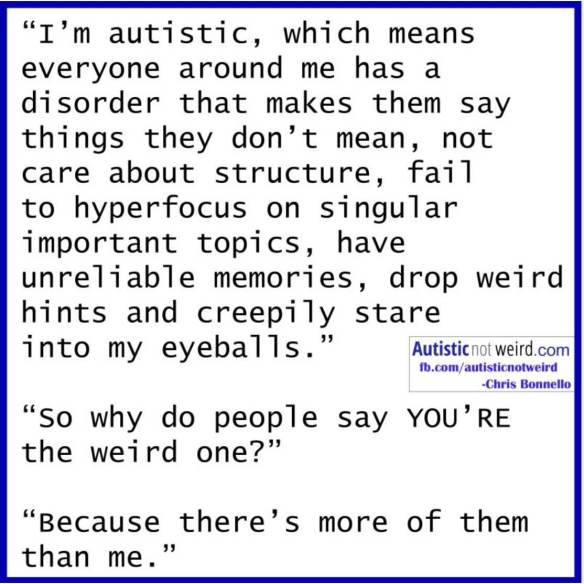
The quote reads:

“I’m autistic, which means everyone around me has a disorder that makes them say things they don’t mean, not care about structure, fail to hyperfocus on singular important topics, have unreliable memories, drop weird hints and creepily stare into my eyeballs.”

“So why do people say YOU’RE the weird one?”

“Because there’s more of them than me.”

(Autisticnot weird.com, fb.com/autisticnotweird -Chris Bonnello)

And the original post by Chris Bonnello calling out this plagiariser is here in this link.

This sort of thing deeply disturbs our autistic sense of justice. But it may not matter as much to non-autistic minds. In fact, publicly calling out injustices, inaccuracies, untruths or half-truths renders many autistic persons vulnerable to attack and even shaming by the non-autistic majority. I left a charity I was passionately invested in because of that. When I raised the issue privately, I was ghosted for a year. They only took notice when I went public. And that resulted in a 40-minute scolding session as if I were a recalcitrant primary school student, the perpetrator digging in their heels justifying a ridiculously inaccurate use of language, nobody standing up for the truth (except for one very gentle oblique but meaningful statement by someone I still respect), a former friend offended afterwards because I did not comfort them with platitudes when they declared themselves ‘guilty’ of not having defended me (I did not even raise the subject, they raised it themselves). I am in a privileged position where I have nothing to lose, and also nothing to gain. But truth-speaking can cost many autistic persons dearly. Loss of employment is a huge example. Yet, repression of truth and justice is an abomination for the autistic mind, leading often to severe burn out and breakdown. When I told them that accurate, clear and open communication is an autistic support need, they said it was “so hard”!!!! Disability support is indeed hard, in that it is inconvenient to those having to support, but isn’t that what a decent society, especially fellow disabled advocates, should be making effort to do?

There is an old Chinese saying: “若要人不知,除非己莫为.” Roughly translated as: “If you don’t want others to know about your misdeeds, keep your slate clean.” It must have been coined by an autistic person, don’t you think?

ABA, Behaviourism and Societal Abuse.

This is a casual piece about my views on behaviourism in general, and my own lived-experience of accumulated trauma and vulnerability as a consequence. It is not an academic article, so I have not provided citations, though the reader can easily find supporting evidence using Google to do a search where interested.


Dawn-joy & Lucy cuddle and leaning cheek to cheek, in fuchsia pink and red, amidst a fantasia of pink peonies, against blue sky and white fluffy clouds.

My strong objection to programmes like ABA and all those behaviour-focused interventions that try to rigorously train Autistic people into mimicking acceptable normative behaviour, and unquestioning compliance to normative societal systems, is not only because they are generally hideously abusive and de-humanising, but more crucially devastating in practice, in my opinion and lived-experience, is the longterm, far-reaching harm that these programmes do to the organic, intrinsic functionality of the Autistic human at the very core. The Autistic person is violently cut away from their natural, unique instincts, and forced to adopt superficial behaviours that do not support the Autistic in any deeper meaningful way, leaving them incapacitated, quietly languishing, silently roaring, weeping in despair and grappling with hapless rage, captive subaltern inside the nauseating swirl of normative Neurocolonialism. It is therefore not surprising to find that the majority of Autistic persons who have grown up receiving ABA now report symptoms of Complex Post Traumatic Stress Disorder.

Continue reading

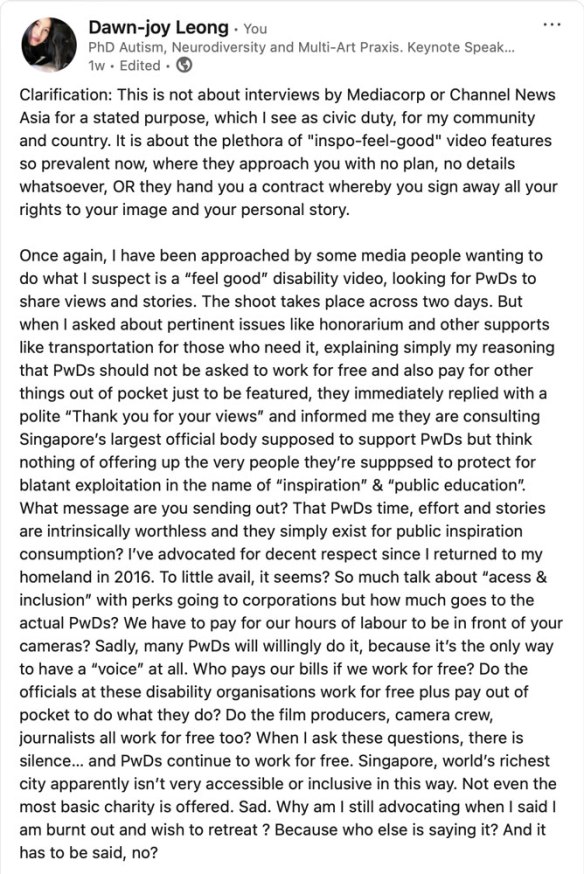
What is Your “Inclusion” Worth?

(See the original post in LinkedIn here.)

One week ago, I made the above post in LinkedIn. This issue has been something I have been trying to address since returning to Singapore in late 2016. Back then, “inclusion” was not the huge buzz-word that it is nowadays. Large Autism forums at the time were being held without a single Autistic person or Autistic researcher present in the room. The voices of persons with disabilities were seldom ever heard at all, although there were beginnings of ‘feel-good’, ‘nice-nice’, ‘be-kind’ videos floating around. Autism “awareness” was only about “lighting it up blue”, and information about autism was the domain of the non-autistic, self-styled ‘experts’ with degrees in psychology but not an iota of lived-experience at all.

Since then, much has changed. Autistic, deaf and disabled voices in Singapore have slowly emerged into the foreground. This is a great thing. I am unsure whether my robust, sometimes blunt and brusque fist-shaking had very much to do with instigating change, but I do know I did play some small part in the churning, swirling, stirring process, alongside a small group of brave and outspoken PWDs and allies from the Disabled People’s Association, other arts practitioners, and allies in the government. From the ground, I know our PWD+allies’ (some almost reckless) outspokenness has opened tiny holes in the thick fog for other younger advocates to step through, and there are many capable disability advocates now doing very well. It was truly a community effort, of which I was merely a tiny spark. I have left the Disabled People’s Association, our entire old Board of Directors stepped down and made way for a brand new team. I am hopeful that new energy will bring better conditions. But we still have a long, long way to go.

Continue reading

Taking Up Space, Holding Space at Salzburg Global

Our First Quiet Table

It’s almost the end of April, and I have been trying to post a daily personal thought-piece on Linked-In on my “taking up space” as a proudly Autistic human in this grand swirl of humanity. Why Linked-In? Simply because I wanted to. Yes, I know it’s not really the kind of thing people post on Linked-In. I see that I am once again doing something almost nobody else is doing. But I am not bothered if nobody reads it or likes it or whatever. I am merely taking up space, holding space, nothing more grand, clever or fanciful. Lucy taught me how to enjoy a posture of meekness without relinquishing enjoyment and security in one’s unique Beingness. It is possible. Not always “comfortable”, but it is another form of Clement Space to me. I thrive better this way. Thank you, Lucy.

I am also wanting to do my part this April, as an Autistic human, in a month that is controversial – loathed by some Autistics and welcomed by others, the latter especially in my region of the world. But not as an Advocate, a label that was placed on me that I never asked for. The hat just did not fit well at all, though I wore it as best as I could, especially in my country when I first returned from Australia, when there was nobody else to stand in the gap. Now, I see there are many powerful advocates, the field of advocacy does not need me, not even in my own country anymore. To be honest, I am relieved. I have been on social media since the days when Facebook began as an invitation-only platform, and blogging was the only way to reach and connect with other Autistic humans. Back then, I did not worry about ‘likes’ of ‘followers’, I don’t think it was even a ‘thing’ at the time. I never did put much importance in this, I was reticent even when the ‘following’ and ‘liking’ started to trend into a full blown slugging match, though I did think that I ought to get in on the act a bit more, but of course failed miserably because my heart and soul were not aligned with that movement anyway, and now, at this point of my journey, it completely does not matter at all. The only caution and thought I have learned through the years to exercise is for my own safety and privacy, because there is so much that is awful about social media these days. For me, I maintain a presence because I want to, and because it is easier to update my few friends and supporters this way, but my main focus is on being a witness to my own journey, telling my personal story wherever I am welcomed, at every interstice I possibly can. My mission is simple. I do all nowadays in honour of Lucy Like-a-Charm, who showed me another dimension of perceiving, receiving and living, and how to be human in my own best possible way. I admit that the ability to choose this path is a luxury and privilege for which I remind myself to be grateful always. I just want to tell our story, nothing more.

This thought-piece is about my personal experience of the observation and upholding of diversity, equity, and inclusion, and receiving the supports I requested, during my latest adventure in Salzburg.

Continue reading