Unknown's avatar

About dawnjoyleong

Autistic. Researcher. Multi-Artist. Embarking now on completing memoir-fantasie, "Wake Up in My Dreams", a multimedia cross-disciplinary autobiography in the form of Fantasia, in honour and loving memory of Lucy Like-a-Charm.

And Suddenly…

And Suddenly

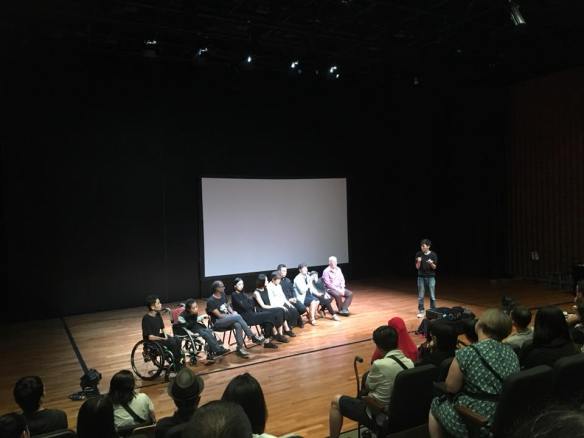
Cast Photo by Victor Kuansong Zhuang. Thank you for permission to use.

Yesterday, I attended the final performance – a matinee – of “And Suddenly I Disappear: The Singapore ‘d’ Monologues“. My friend, Alvan, has written a brief review of the show here. I like some of his views on it, and I highly recommend a quick visit to his blog post.

This isn’t a review of the play, really, it is more a sensory recollection. Continue reading

Disabled Leadership in practice

In a previous post, I mused about Disabled Leadership, the great divide between theory and practice that many disabled persons face, and suggested one fundamental element that is crucial to recognition of disabled participants in the conversation on disability: payment as a basic mark of respect. Now, in this brief ‘follow-up’ post, I’d like to provide some straight-forward concrete examples of its practice in the arts and film.

I’ve iterated and reiterated before, and now once more, I am no activist – I have an aversion for confrontational activity, but advocacy is something that most disabled professionals are forced to engage in (in some way or other) due to the dominating climate of ableism and stubborn ignorance surrounding the disabled practitioner. In other words, advocacy – sometimes quite vehement and insistent – is made necessary because disabled practitioners need to clear the debris-strewn paths, clogged channels, and polluted waterways so that we can proceed with our practice. Continue reading

Reluctant Advocate

I am not an “Autism Activist” – far from it – so, please do not call me that. Thank you. I do support the work of activists, it is a necessary force when things are woefully wrong and a great deal of vim and vigour is needed to create change for the better. It is just that my natural constitution does not fit well with the vivacity required for effective activism. Sometimes, though, I do engage in advocacy. Well, all right, quite often especially of late, but this is not what I deliberately set out to do. I am, first and foremost, an autistic researcher and multi-artist. Unpacking this further, my research interests include (but are not confined to) autism, autistic sensory idiosyncrasies, alternative and elemental empathic resonance, clement spaces of mind and body, and my material practice reflects this research, employing multiple artistic disciplines. I love my research and multi-art practice, and I adore my beloved Lucy Like-a-Charm, the two represent mental, emotional and physical wellbeing and equilibrium to me. Continue reading

Disabled People Have an Ally Problem: They Need to Stop Talking For Us

Important points very clearly put forth. Disabled Leadership can and must happen, but first, the ground needs to be laid. And this article lays it down very well. Read and learn!

Imani's avatarCrutches and Spice

My mom and I were in the store when it happened. It wasn’t the first time and it wouldn’t be the last, unfortunately. It was a common occurrence, “par for the course” as they say. An acquaintance of my mother (my mom’s real friends know better) had walked over to us and started a conversation with us. Just normal things until she switched the conversation to kids, she looked and my mother and asked “what subject does she like most in school?” Despite standing right beside my mother, despite having been introduced to me by my mother, despite the fact I had nodded quite attentively to what she had yammered on about, she decided to ignore my presence and address the question to my mother. For most abled people, this may seem like a momentary slip up in decorum, but for disabled people this is all to familiar: proximity to…

View original post 570 more words

Disabled Leadership in theory & practice

There is increasing talk about Disabled Leadership in the Arts. There are stirrings, positive ones, potentially amazing even, in the arena of the Arts and Disability. (Even in wider fields, for example Autism Research – just reading the Twitter feed coming from IMSAR2018 indicates that level of Actual Autistic participation has increased and that is a cause for hope for a better future in research and practice.)

Excitement and awareness aside, there are still some brass tacks issues to face and tackle head on. Before we can even make that leap into Disabled Leadership, there needs to be some basic concepts of respectful and ethical interactional treatment of disabled people. How do we establish leadership if the non-disabled world cannot even bring themselves to the level of viewing disabled people as human beings worthy of esteem and regard as equal participants in society?

A fundamental topic is that of payment. Yes. Money. And plain simple respect. Let’s start here. Continue reading

bloviation & the sacrificial lamb

My recent casual blog post, musing on Arts and Disability, and the devastating effects of non-disabled colonisation of the disability conversation, theory and practice in any field, with a focus on the arts, simply because this is my field of research and praxis.

“Perhaps it is time to take the entire conversation back and situate it on our own platform – the Actually Autistic / Actually Disabled stage. One that we choose for ourselves, not that which is designed and built by the non-disabled colonising forces. One in which there is no prerequisite social-political posturing of ambiguous, veiled or hushed up mumblings, no copious mists of gas lighting, and no contemptuous slime of condescension. Just honest truth and a light shining onto a path ahead clear of the debris of gurgling bloviation. Is this even a possibility, I wonder?”

Autism & Mental Wellbeing

Back in Singapore! Hit the ground running. Two more lectures upon my return from Hong Kong.

“Autism & Neurodiversity – lived-experience & the way forward” – NUS Psychology. Thank you, Dr. Iliana Magiati, for the invitation to address your class of future psychologists on neurodiversity and actual autistic insights into autism.


“Autism, Mental Wellbeing & Higher Education” – NUS Office of Student Affairs. An important topic. Autistic students in universities have to navigate a minefield of sensory, social, political & executive function complexities. Specific considerations and supports / accommodations are necessary. First, let’s look at autism from the viewpoint of Neurodiversity, ditch that pathological model, it doesn’t help at all!

(For enquiries on talks / workshops / training sessions, please email me at dr.dawnjoyleong@gmail.com)

Autism & Neurodiversity in Hong Kong

HKU-CGED-Talk

This slideshow requires JavaScript.

I was in Hong Kong recently, speaking on Autism and Neurodiversity. An amazing week. Hope to see you again soon, Hong Kong!

(For enquiries on speaking engagements, please email: dawnjoy@mac.com)

Upcoming Lectures – Hong Kong Feb/March 2018

I shall be in Hong Kong next week and a half delivering two public lectures. Friends in Hong Kong, please do drop by!

1. EMBRACING NEURODIVERSITY

Embracing-Neurodiversity_poster1

Embracing Neurodiversity: sharing empathy through multi-sensory immersive art.
Venue: University of Hong Kong, Room 4.34, Run Run Shaw Tower, Centennial Campus.
Date and time: 28 February 2018, 4-5.30pm
Language: English
Contact: Ms. Zhang Xuehong – xuehong@hku.hk

Abstract:

Empathy is a complex concept: an abstract phenomenon that can be felt, but remains invisible and unknown to others unless properly conveyed. Each human culture has different ways of expressing and showing empathy. Nonetheless, empathy is an important part of human interaction and a key component to forming congenial relationships.
According to the neuronormative-designed pathological description, the autistic person is a social misfit without ability to form meaningful connections, in a barren mindscape devoid of empathy and creative imagination. In reality, the autistic realm is a rich and vibrant sensorial ecology teeming with detail, observations of minutiae, and dynamic energy; and autistic persons possess a different kind of empathy, an alternative connectivity that is no less meaningful than that of the social normative majority.

Autism has been scrutinized and defined by the neuronormative for almost a century, yet the normative realm has failed dismally to understand the autistic existence. Perhaps it is now time for the autistic world to show the way forward, with multi-art practice as agency, towards deeper empathic resonance across neuro-cultural divides.

2. AUTISM & ART

V1-20180302-Poster


Autism and Art

Another talk I will be delivering in Hong Kong, this one is at the Education University. The poster is in Chinese, as the audience in this one will be mainly Cantonese speaking. My lecture is in English with simultaneous Cantonese translation. There will be a show by autistic sand-artist, Sai-Ho Lee to open the session, and a Q&A at the end.

Topic: Autism and Art.
Venue: Education University of Hong Kong, Lecture Room 105
Date and time: 2 March 2018, 2-5pm
Language: English with Cantonese translation
Contact: csenie@eduhk.hk

Abstract:
For many autistic persons, life within the context of the wider social world is a difficult journey full of stigmatization and misunderstanding. How may artistic research and practice help to bridge the divide between neurotypical and autistic realms, to forge real and lasting empathic connectivity between?
對於許多自閉人士來說,活在這個社會猶如踏上一條充滿負面標籤和被誤解的艱難旅程。講者透過藝術研究和實踐,探索如何跨越非自閉和自閉特色世界族群的鴻溝,形成真正持久和具同理心的連系。