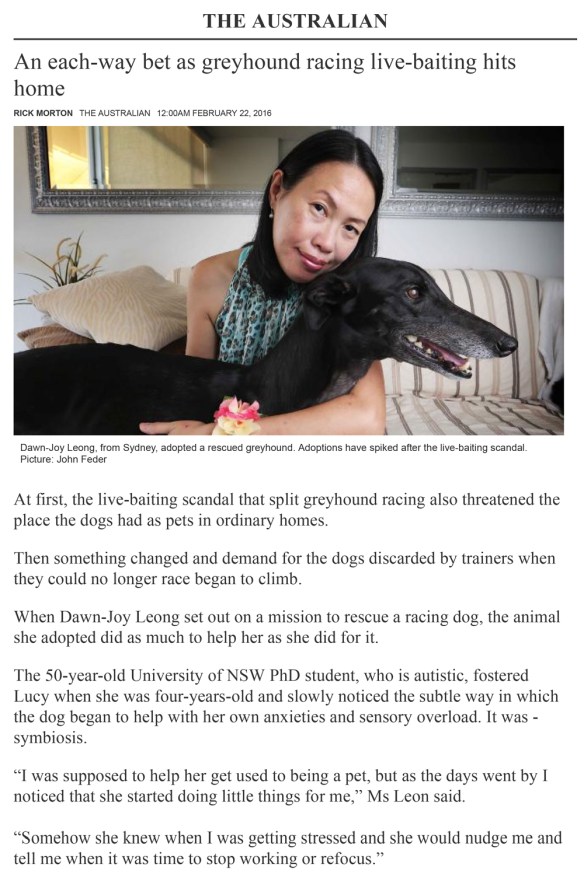
A throwback to my Greyhound advocacy days with Lucy in Sydney, Australia. It was an exciting year, campaigning for the ban on Greyhound racing, winning then losing, rising and falling.
Now, Greyhound racing is finally being banned and dissolved in many places around the world. In Australia, with Tasmania leading the way forward. I hope very much that New South Wales, where we originally began our journey together, will soon come around,
Thank you, Lucy, for opening my heart to this world, teaching me how to speak up for the greater good of not only humanity but also the non-human entities that help humanity to live better, stronger, gentler and kinder one to another.
In this article, I not only speak about the cruelty of Greyhound racing, but also about how Lucy and other assistance dogs help and support persons with disabilities live fuller and richer lives.
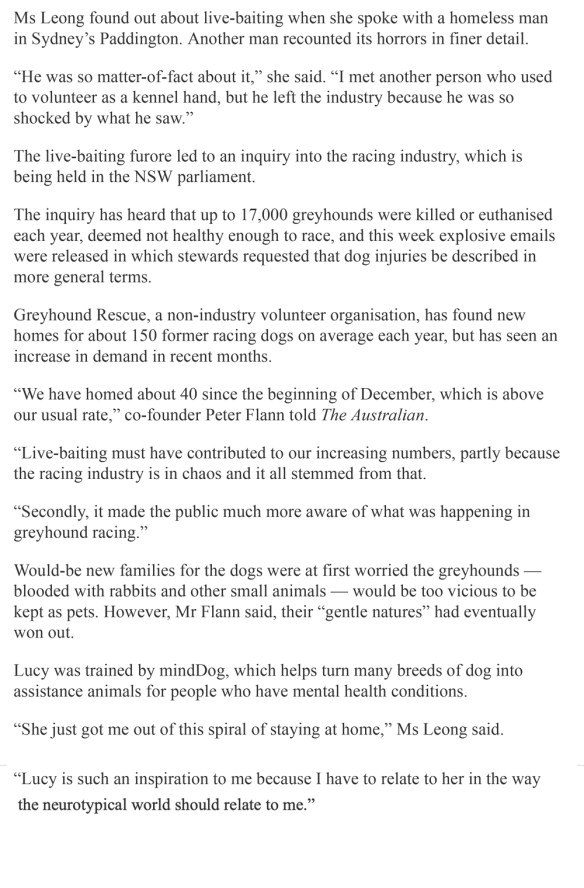
Excerpt from Project WebPage: Lucy Like-a-Charm. Please visit this link for full information.
Presenting my latest project…
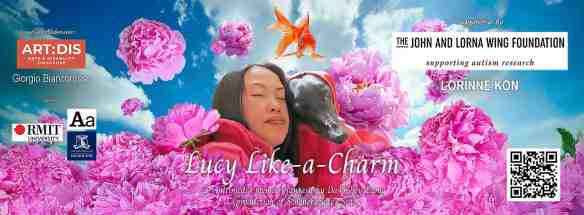
Lucy Like-a-Charm
– a multimedia, multi-access memoir-fantasy about an Autistic woman and a Greyhound dog on a magical journey towards Becoming – empowered by Love, transformed by Grace.
My thought-post today in LinkedIn. I am seldom there, because it’s not my favourite milieu, but the AI experts I mentioned are very active in LinkedIn, so I posted this there to let them know their work has impacted me. I always try to recognise people who have helped or inspired me in some way or other.
Image description in Alt Text but copied here too: White on black background, sketch of Lucy greyhound. Nose tilted downwards towards her left, eyes looking down enquiringly, her ears are relaxed but perked, ready to take on new information. She wears a blue brocade collar with a large red flower. This sketch is from a photo of Lucy taken at SYNC Sg 2019, I was sitting on the floor, exhausted in near shutdown, and she got up from her fluffy mat, and was looking at me, always caring always alert to my needs.
Sketch of Lucy Like-a-Charm – speaking without words.
I don’t know much about AI, but I became interested after hearing Wan Wei, Soh & Ammar Younas in a panel speaking passionately about AI during SIBOS2024 in Beijing. I’ve also been reading articles posted by them & Tony Fish. As an Autistic autism researcher & multimodal transdisciplinary artist focusing on alternative sentience / empathic resonance and parallel embodiments, AI fascinates me. In an early experiment at my university in Australia, more than 10 years ago, I found that I was far more comfortable alone in a room with a humanoid robot, than with a real human stranger, & the experience stayed in my mind. That comfort level was not at all close to what I enjoy when I am with amiable non-human animals, nature or the elements, but definitely better than with humans. Now, thinking about AI, and the fact that AI entities are already beginning to develop “personalities” of their own – fundamentally, if AI is ‘fed’ the right kinds of information about neurodiversity, Autistic, neurodivergent, neuroholographic states of Beingness, would it then not follow that the AI entity would be a far more comfortable, comforting & even, dare I say it, empathic companion than the average misinformed, prejudiced & discriminating ‘real’ human? And then, the question: Who therefore can be said to possess more “humanity”? The AI entity developed with the right perceptions & attitudes, or the average human holding onto erroneous & harmful notions without wanting to expand their thinking?
Regardless, I believe that the effort of studying the human state-of-being still desperately NEEDS to include wisdom gleaned from non-human animals, nature & the elements, the fundamental expansion of our narrow mindsets to consider alternative sentiences, not to be afraid of the possibilities, but to be confident that our human percipience CAN and WILL handle it all, if we are willing to embrace new understanding with respect & for the sake of the greater good, not just of humankind, but all that we are intricately intertwined together with, inside a beautiful multidimensional tapestry of Being.
I’ve been badgering research institutes & researchers to consider this trajectory for serious study, especially efficacious if from the Autistic / neuroholographic viewpoint, but to little avail. Humans are still so obsessed by navel-gazing, I fear a self-destruct moment if we do not reach outwards to learn. Some scientists (S.Simard) are already proving what many Autistics always knew, even from childhood: that trees can & do communicate meaningfully. Therefore contemplating alternative sentiences even further than that of non-human animals. But Autism research is still stuck deep inside human-centric psychology, psychiatry, sociology etc disciplines. There is a vast universe out there yet to be explored, but few want to do so. Autistics do but without agency, we cannot do much. Yet. I still hope. In my lifetime? Will AI help?
Grateful thanks to Swift Innotribe for the opportunity to speak at this prestigious event, and to Speaker Ideas, who now manages my corporate engagements.
It’s time for the next round of awards. The above video was made by Mediacorp to herald this upcoming event.
I mean it when I say simply that I am at best a reluctant disability advocate. My worldly “achievements” have never been a part of my conscious goals, whether long or short term. There was just one dream that I made huge effort, and ultimately extreme sacrifice, to attain: my Ph.D and the journey towards finding Selfhood, which are intertwined and inseparable. Those years as a Ph.D scholar were the very best years of my life. No regrets at all. The best thing I have done for myself. The subsequent awards, accolades, recognition and media attention were and still are secondary, quite unexpected and, to me, a burden even, which I bear as a consequence of the universe’s generosity towards me. Paying it forward.
My worth is not even remotely associated in any way any social commendation. I said it very clearly in the first chapter of my Ph.D dissertation, my path is an inexorable one, I am merely custodian and facilitator to the artistry that seems to emanate from me, but which I know is actually the result of my connection with the vastness of the universe. It is an entity in itself, with a path of its own. I follow and I allow myself to be a channel for its expressions, to the best of my capabilities. The process – the journey itself – is my reward and honour. I am less interested in the final product or what the system refers to as “outcomes” which I find dreary and at odds with my artistic quest. How does a true artist actually measure “outcomes” in terms of clicks, views, audience numbers, churning and turning statistics? It cheapens the art, and produces mediocrity. The same with measurements for prizes and awards. The structure itself is faulty. Not every winner is a true winner. Some winners are there because of political and social reasons, some because of sheer determination and relentless, repeated attempts, and then the few who truly deserve the recognition. I am Autistic, the social-political mechanisms of the normative world are a puzzle to me, but I accept that I have to live in and try to survive and even thrive in this alienating clime. Yet, in my quest to navigate this minefield, I am not at all competitive. Yes, I do speak out when I see an injustice or moral / ethical aberration – often bluntly, without the nice-nice frills and embellishments that normative society so values and insists on – but in truth, I am no warrior at heart. I merely wish to Be – undisturbed, well supported, and freed to give back to others the blessings I have received.
Thank you, world, for the amazing awards and tributes, I am grateful to have somehow unwittingly stumbled upon them. But all I really wish and yearn for is Clement Space, with Lucy, and facilitation to follow what is organic and intrinsic.
So, if there is one takeaway from this part of my adventure, as a ‘prominent’ disability advocate, it is this: YOU are worth it. Disabled or not. Your worth is within you. And only you can determine this. All else is ancillary.
I have to say this episode was the most unsettling to watch – almost sliding down the slippery slope of the tragedy-cum-heroic narrative, this episode featured two ‘strong’ women speaking about their lives with their autistic children, who are now young adults.
I felt very sad for the young man, Zhen Yu. Far be it for me to doubt his mother’s love for him, her dedication towards the young man pervaded the space, but there were many moments in her interaction with the young man that made me cringe and even bristle. I felt his distress, there were moments where I knew he was attempting to communicate, but the mother completely missed the gestures and sounds he made, and she chided him, as if he was a naughty toddler making a nuisance of himself, preventing her from ‘adulting’ in front of the camera. There was a split second where she even grimaced and rolled her eyes. There was a sense of embarrassment, she looked exasperated and annoyed, when interacting with him. The mother spoke mostly about her hopelessness and despair, not his.
The other autistic young person, Edura, appeared to be happier – there was a lot of physical affection going on and some smiles and laughs. Edura’s mother runs workshops or ‘sharing’ sessions for other mothers with autistic children, on physical touch and muscle relaxation. I did cringe at the word “heal” – just like “cure” and “recover” all speak of ableist concepts of autism as a scourge / disease – but I’ve come to expect it of the neuronormative way of thinking.
The first episode of “Uniquely Me” – a series about autism and autistic lives in Singapore – aired last night on MediaCorp’s Chinese Channel 8. Immediately afterwards, there were rumblings and rants emerging from the adult autistic community in chat groups and on Facebook.
Background
Some contextual background is needed before I launch into my own perspectives and reactions to this twenty minute show.
Autistic people – we are an oppressed and traumatised, vulnerable and hurting community worldwide. As autistics, we are already predisposed towards hypersensitivity, detail orientation, and communicate with the world in ways unlike the normative. Add to this the accumulated collective cultural history of Autism (see Steve Silberman’s “Neurotribes” – the best book published thus far on the history of autism), and the specific situation here in Singapore, where the perception of autism as a whole is mired in the old medical model, and autistic people are generally presumed incompetent rather than competent, completely devoid of our own voice / voices: we have thus acquired a collective trauma, and individual heightened anxiety around the subject of Selfhood. The setting is a painfully raw, tender, largely confused and ignorant, and emotionally volatile scenario. It is not surprising, then, that many in the adult autistic community have reacted explosively, with anger and shock, at this very stark presentation of autistic persons with complex needs in the first episode. Continue reading →




 Dawn-joy Leong