SBS Online News Feature on Autism & Neurodiversity
by Mark White

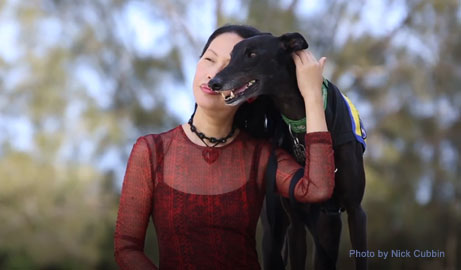
Dawn-joy Leong and Lucy present
Sonata in Z
10-14 November 2015 | 10am-5pm
Nick Waterlow Gallery, UNSW Galleries
UNSW Art & Design, Paddington, Sydney, NSW, Australia.
Sonata in Z is a ‘gentle space’, inspired by my autistic hyper sensory quest for sanctuary, and my Greyhound Lucy’s natural ability to seek out and create oases of comfort. Unfolding like a musical sonata, visual images of Lucy in sonorous repose introduce the theme of rest. Please leave your shoes at the threshold as you enter, symbolically shedding conventional notions of social communication. Once inside, we shall not speak in words, but the tranquility is neither silent nor empty, because our senses will lead the way into a different social ecosystem of softly undulating rhythms, patterns, sounds, movements, gestures, textures, smells, tastes and visual conversations. This is our refuge, an alternative empathic resonance, a nonverbal sensory equilibrium – and Lucy and I would like to share our clement space with you.
Limited edition photograph posters available for order. Professionally printed on fome-cor or gatorboard. For information on size, print and price details, please contact Dawn-joy at scheherazadessea@gmail.com Continue reading
Autism and me: a lifelong quest for Beingness and clemency of Being.
Guest lecture, 27 August 2015, School of Education, UNSW, Australia.
Thank you, Dr. Iva Strnadova, for inviting me to deliver this guest lecture since 2012. It has become an annual event I look forward to greatly.
I promised Iva I’ll tell as many personal stories as possible within the time limit, and so I shall. But before I launch into the dramatics, I’d like to begin with some basic terminology.
When I first began on my research journey, I adopted the prevalent deficits-focused, pathological perspectives and terminologies, because that was all I knew at the time. However, I henceforth prefer to use the term “Autism Spectrum Condition” instead of “disorder,” because this better describes the neurological culture that autism actually is. I also no longer use functioning labels – “high” or “low” functioning – as they are not only insulting to autistic persons, but more importantly they are based on a system of measurements that does not properly respect the innate autistic functional modalities and paradigms.
Now for my fabulous stories. Continue reading
Paper presented at UNSW Art & Design Postgraduate Conference, 17-19 June 2015.
——
My Ph.D dissertation, tentatively entitled, Scheherazade’s Sea – autistic parallel embodiment and elemental empathy, is part of a protracted journey in search for Being: a detailed study of Self and Other, and examination of multidimensional interstices of dynamic, interactive reciprocities.
This research and practice rests upon three fundamental concepts:
The theoretical foundation for this work is constructed from documented studies in neuroscience, anthropology, the arts and humanities, and personal anecdotal evidence from autistic individuals. At the same time, my artistic practice acts as concretising agency by creating experimental ‘sharable’ spaces that serve not merely to display autism but to invite dynamic, personified communion; connecting individuals across neuro-functional divides. Continue reading
Conference paper presented at the Inter-Disciplinary.Net conference,
Strangers, Aliens and Foreigners
Thursday 5th September – Saturday 7th September 2013
Mansfield College, Oxford, United Kingdom.
(This paper was first published in the ebook, “Experiencing Otherness: Multidisciplinary Perspectives”.)
Abstract.
Culture is the agglomeration of values, customs, and communication systems identifying groups of people, where demarcations can be geographic, economic, intellectual, or even neurological predisposition. In this paper, I shall discuss Autism Spectrum Condition as a mental culture, and investigate Self-Other identities from the perspective of a researcher-artist with Asperger’s Syndrome. Autism is widely portrayed by the general media as stereotypes exhibiting bizarre behaviour. Why is autism considered an aberrant existence? In reality, autistic individuals grapple daily with the complexities of Self and Other. Assimilation and communication is very much based on the autistic individual’s ability to grasp and ‘perform’ alien systems and realities. How much should we conform to the cultural tenets of Other at the expense of Self for the purpose of convivial integration, and how much to attend to Self for the sake of intrinsic preservation and need?
In the push for a more enlightened co-existence, some questions require address. When is co-existence considered cultural migration and when imposition? We are often strangers even in our own ‘homes,’ perennial actors and performers of Other, and thereby losing understanding and appreciation of Self. Should it be a compliment or insult when someone declares, “But you can’t be autistic, you don’t look or behave autistic?”
Perhaps a transdisciplinary approach to this conundrum is in order – one that will facilitate understanding and reciprocity between Self and Other. Continue reading
This is a musing about invasion of privacy and the thin fine line between funny and sinister.
When one has been accorded much care, consideration and respectful support from a great number of people, one may become not only quite overwhelmed, but also lulled into a feeling of security, such that when this sense of ‘safeness’ is challenged, one becomes suddenly unsure how to react. One incident was highlighted in my previous post, “Confronting the Invisible.”
Recently, I have been encountering a series of little events, each one so minute in isolation that only the very observant or meticulously private person would react to, let alone notice at all. I have tried hard, in deference to the more prevalent “hey, relax!” laissez-faire social perception of the majority, to downplay in my own mind, each of these events which nevertheless irked me greatly. However, now that I am faced with an escalating rate of recurrence of these ‘small things,’ and the accumulation of which are forming a disturbing but as yet nebulous denouement with an accompanying mixture of utter weariness and foreboding, I am finding harder and harder to brush them all off. Continue reading

Guardian Angel
This is a musing about confronting, and the confrontation of invisible disability.
What happens when the invisible is confronted in a stark and abrupt instant?
A recent encounter inside the lift on my way up to my art studio brought me once more, eyeball to uncomfortable eyeball, with the conundrum of ‘framing’ an invisible neurological difference. In my case, it is autism – and this is an issue that autistics living in the normative realms are constantly faced with, because we exist and function in the midst of, and juxtaposed with, the ‘normalcy’ of neurotypical constructs and systems. Continue reading
Paper presented at the International Conference for Research Creativity: Praxis, Baptist University of Hong Kong, 21-23 November 2012.
—
How should the artist approach practice and research without becoming so overly abstract that the grounded, proprioceptive concreteness of art becomes mired inside oppressive, draconian intellectualism? The reciprocal processes of researching artistic practice and practicing artistic research require actively synergetic, symbiotic sensory and cognitive engagement, the interaction and inter-reaction of the bodily senses with theoretical, philosophical insight and invention.
Sensorial contemplation, that is, “thinking through the body,” is an inherent trait of Autism Spectrum Condition. How do autistic sensory, proprioceptive and cognitive idiosyncrasies affect creative motivation and process? May the model of autism inspire a fresh perspective for research and praxis? As an artist with Autism Spectrum Condition, the aims of my paper are to provide an ‘insider’ view of how sensory and cognitive idiosyncrasy shape my creativity, and using the autistic body-mind model, suggest an alternative milieu for creating visionary collaborative research, and mutually empathic platforms. Continue reading
** Note: This article is more than ten years old, and contains some outdated terminology. My ideas and perspectives have grown, evolved and shifted since, but I am presenting this unedited as a documentation of my journey.
Paper presented in The Arts in Society 2012 conference.
First published by The International Journal of the Arts in Society: Annual Review, Volume 7 (2013), p. 29-39; and in the The International Journal of Arts Theory and History, (Common Ground Publishing).
Dawn-joy Leong, 2012.
Abstract:
What are the semiotics and meanings of art to a small, hidden sector of society with sensory and cognitive anomalies? How do these idiosyncrasies shape creative process? Much attention is now centred on Autism Spectrum Condition. Researchers in the fields of neurology and psychology are presenting more and more discoveries, as a growing community of autism self-advocates and associates are finding increasingly louder voices in the media and online. Inevitably, claims, counterclaims, heated discussions and bitter disputes abound. In the area of artistic creativity, there has been great interest in the particular talents attributed to individuals with autism. Books, articles and papers are being published on this subject, and an assortment of therapies aimed at developing these abilities are being proffered, while parents grasp at any and every suggestion of hope and reassurance about their children’s latent potentials. However, most of the postulations and assertions emerging about autism and creativity are from the non-autistic observer, and there are, to date, very few practising artist-researchers with autism stepping up on this platform rife with confusion and controversy to present their ideas from the personal vantage point. As an artist and scholar with autism, my interest in the area of multimodality in art is very much entrenched in my idiosyncratic sensory and cognitive profile. The aim of my presentation is to provoke more consideration towards the multisensory dimensions and potentials of artistic practice, as well as make a fledgling contribution of much-needed autobiographical empirical perspective on autism traits and the creative process. For the purpose of concrete illustration, I shall provide a brief overview of my most recent work, Scheherazade’s Sea, as an example of how sensory anomaly and neurodiversity shapes my creativity as an artist-researcher with Autism Spectrum Condition.
Keywords: Autism Spectrum Condition, Creativity, Hypersensitivity, Sensory and Cognitive Idiosyncrasy Artistic Process, Multimodality, Multisensory
Continue readingThis is the extended version of the lecture I delivered at the School of Education, UNSW, on 14 August 2012, to an undergraduate class, at the invitation of Dr. Iva Strnadova. Some of the content are repeated from an earlier lecture. The actual lecture was deliberately shortened to make time for a more interactive question and answer session. I thoroughly enjoyed the wonderful response and rapport, and any further communication on the subject is welcome!
 Dawn-joy Leong