Grateful thanks to Swift Innotribe for the opportunity to speak at this prestigious event, and to Speaker Ideas, who now manages my corporate engagements.
Scheherazade’s Sea 2021 was yet another groundbreaking work, at least in my country: led by a disabled artist, featuring other disabled artists, with excellent disability support professionals, and Singapore’s most experienced director in the arts and disability sector. It was a bumpy ride, to say the least. But I am ever grateful to our team for their dedication to my mission, their strength and verve, and especially to my closest ally, Director Peter Sau for his unwavering loyalty, even when things were rough and uncertain. The greatest practical challenge I faced in this project was honouring my own ethics of practising true inclusion the way I feel it ought to be practised. The grant I was awarded was a small mainstream grant, for an experimental work-in-progress, but with no additional allowance for disability support. Therefore, if I wished to provide any disability support to my cast at all, the expenses would have to be gouged out from elsewhere in the budget. I refused to ask my cast to pay out of pocket for anything as far as I could help it, unlike how other projects claiming “inclusivity” make their PWD participants contribute their time, effort and energies in exchange for “exposure” and nothing more, and so the money came from my own artist’s fee, as well as all other technical editing work. The project stretched across a year. That meant that I had to find other means to support myself. It also demanded that I single-handedly record, edit, create all the special effects, captioning, labelling, video editing and rendering etc. I had never attempted this level of technical work before, and so, completely untrained, I had to learn everything from scratch. I also had to procure a faster computer in order to do the rotoscoping effectively. There was no budget for this kind of equipment. I was working 18 hour days in the final stages of the production, despite a fragile physical condition. My medical bills hit the roof, just so I could stay alive, awake and still functioning, in order to complete the work. I owe my survival to Lucy’s constant companionship, and the strength and inspiration to keep going that she brought to the darkest nights and most frustrating moments of failure during this amazing learning adventure. Rotoscoping was the most difficult technique, which I still could not quite master, and that is quite evident in the outcome. But I remind myself that it was a monumental feat to be proud of anyway, and this was meant to be an experimental work, not a polished, slick piece of videography. This experience highlighted the lack of recognition in our arts sector for the needs of artists with disabilities. A complete disregard, in fact. But I have no regrets whatsoever, the journey in itself was worth all the excruciating pain, because of Lucy who was by my side throughout, and the wonderful humans who walked side by side all the way with me, without complaining, never losing faith and trust in me.
(Watch full video on Youtube if it cannot be played here – 31minutes)
Scheherazade’s Sea: continuing journey, 2021, was a year-long project. There were many “firsts”. Personally, I have always presented my “Scheherazade’s Sea” series as a solo artist – creator and performer. This rendition unpacks the continuing adventures of Scheherazade with a brand new approach: Scheherazade was played by the talented singer, performer Claire Teo, and joining the team were two other artists, Timothy Lee and Ariel Koh. This made Scheherazade’s Sea: continuing journey, 2021, not only disabled-led (conceptualised, executed and co-directed by me) but also a work featuring a cast of differently disabled artists at various stages of their artistic journeys.
Freelance artists around the world struggle to make ends meet. In Singapore, where the arts is even less valued by society, this struggle can sometimes be very fierce. For freelance disabled artists wanting to turn professional, and departing from the charity models, the scenario is bleak. But artists always hold on to hope, keeping our dreams alive even if by a thin thread. Since Scheherazade first appeared in 2010, my personal and professional journey has been an amazing one, at times tumultuous, but always incredibly thrilling and never boring. It is a story of survival against the odds and unexpected achievements – all of which I owe to my party of valiant human supporters and to Lucy Like-a-Charm. Upon returning to Singapore, I decided that this part of my life’s journey will be one that is actively “paying it forward” for as long as I can create art.
Scheherazade’s Sea 2021, is about newness – finding new friends and loyal supporters, and being gifted the honour and blessing of Clement Space in the form of a differently embodied creature named Lucy Like-a-Charm. In honour of all the people who have supported me so generously in a plethora of ways, I decided to now use Scheherazade’s Sea 2021 to provide practical spaces for other disabled artists in Singapore, open up mentorship and learning experiences they may not otherwise have access to without the benefit of an overseas education (which I had the privilege of enjoying). Beyond the narrative and multi-dimensional aspects of the work itself, my intentions were for this work to be a true-to-live rigorous yet safe space for professional training and experience for the cast, wherever they may be along their own paths. I could only do this, of course, with continued support from my faithful friends, my younger sister Althea, and my confrèrePeter Sau, who began my Singapore journey for me. I was inspired by Peter’s vigour and spirit in his seminal work “Project Tandem” and his role in “The Singapore ‘d’ Monologues,” and am thankful for our serendipitous meeting – because, being autistic, I have no idea how to network like neurotypical people do and so every angel in my life is to me truly a gift of providence. Thank you, Peter!
Scheherazade’s Sea 2021 is also a practice-based research into navigating the realm of the so-called ‘invisible disability’ as well as un-noticed vulnerability, and forging new strategies to artistic practice that provides access in ways that are unavailable in traditional approaches and methods.
A note on why I continue to make this work freely accessible to all on Youtube, despite having been told to keep it away from the public eye in order to pitch it to various festivals and events in Singapore and overseas. When I created Scheherazade’s Sea, way back in 2010, I meant it to be a richly textured work that everyone and anyone could easily partake of, without exclusions or arbitrary boundaries to separate people. That intent still prevails today, and even if it means no festival or big event would now want to feature this work, it is ok. The latter will be a feather in my cap and that of all the cast and crew, most definitely, but I prefer still to stay true to my raison d’être here:
I hope you enjoy the video and if you are a curator, we would, of course, love the opportunity to be featured in your festival or curated collective show if you understand my decision to make this video even more widely publicly available.
If you’d like to read my opening speech at the online premiere, please click on this link.
Video excerpts below, if you’d rather watch small, key segments instead of the long full version.
Cast Photo by Victor Kuansong Zhuang. Thank you for permission to use.
Yesterday, I attended the final performance – a matinee – of “And Suddenly I Disappear: The Singapore ‘d’ Monologues“. My friend, Alvan, has written a brief review of the show here. I like some of his views on it, and I highly recommend a quick visit to his blog post.
This isn’t a review of the play, really, it is more a sensory recollection. Continue reading →
In a previous post, I mused about Disabled Leadership, the great divide between theory and practice that many disabled persons face, and suggested one fundamental element that is crucial to recognition of disabled participants in the conversation on disability: payment as a basic mark of respect. Now, in this brief ‘follow-up’ post, I’d like to provide some straight-forward concrete examples of its practice in the arts and film.
I’ve iterated and reiterated before, and now once more, I am no activist – I have an aversion for confrontational activity, but advocacy is something that most disabled professionals are forced to engage in (in some way or other) due to the dominating climate of ableism and stubborn ignorance surrounding the disabled practitioner. In other words, advocacy – sometimes quite vehement and insistent – is made necessary because disabled practitioners need to clear the debris-strewn paths, clogged channels, and polluted waterways so that we can proceed with our practice. Continue reading →
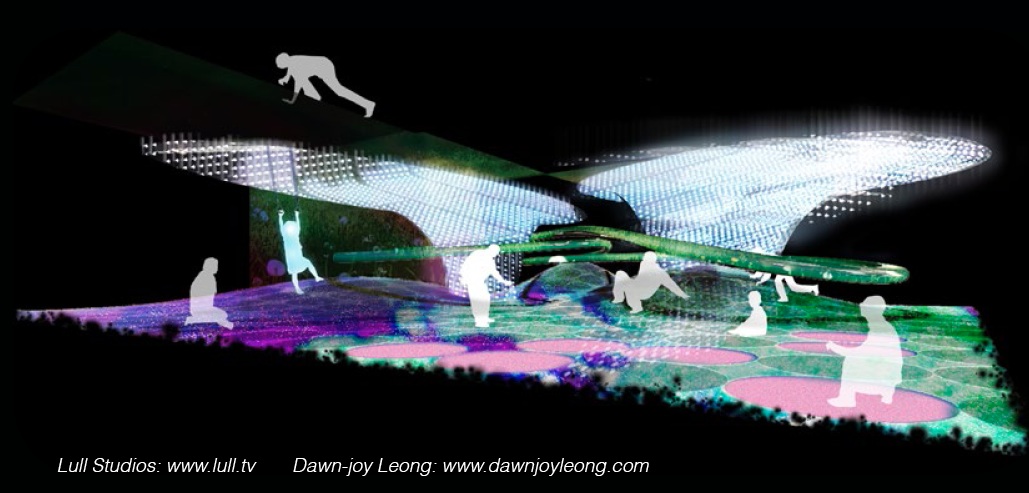
Snoösphere 2017 – a multisensory experience with a focus on autism, featuring autistic creative partnership.
Lull Studios and UNSW would like to invite autistic persons of all ages to join us as creative advisors in designing a gallery-based art installation.
Snoösphere is a space made up of interactive sound, vision, aroma, and touch-controlled elements, in which people can roam and explore. It is an immersive space for promoting discovery, empathy and understanding of the spectrum of neurodiversity.
Named for the noösphere, which is the phase in the Earth’s evolution after the biosphere – a future planetary sphere of mind – the Snoösphere promotes embodied consciousness of the sensory and energetic properties and performance of physical space.
We see this as the especial province of autistic artists. Instead of being passive end-users, autistic participants are an influential part of developing Snoösphere, putting into practice the ethos “Nothing About Us Without Us.”
Dr. Dawn-joy Leong is the autism consultant for Snoösphere, personally facilitating the interesting and fun autism-friendly sessions.
Participants will experience creative engagement and learn about the process of building a multisensory interactive environment aimed at supporting the sensory needs of autistics. Contributions from our autistic advisors will be duly acknowledged in the final production.
Introductory consultation sessions and workshops for small groups and individuals (completely free) will be held 17-20 November 2016, at UNSW Art & Design, Paddington.
Please feel free to contact Dawn-joy for more detailed information, or to register your interest in becoming part of our project. Dawn will reply to emails promptly and no question is too trivial.
UNSW Art & Design, Paddington, Sydney, NSW, Australia.
An autistic human,
A greyhound dog.
Parallel Embodiments,
A journey of Being.
Endeavour of empathy,
Spaces of mind.
Sonorous communion,
Wordless interlocutions.
Enter barefoot
Scheherazade’s Sea:
Dancing
Awake
Inside dreams
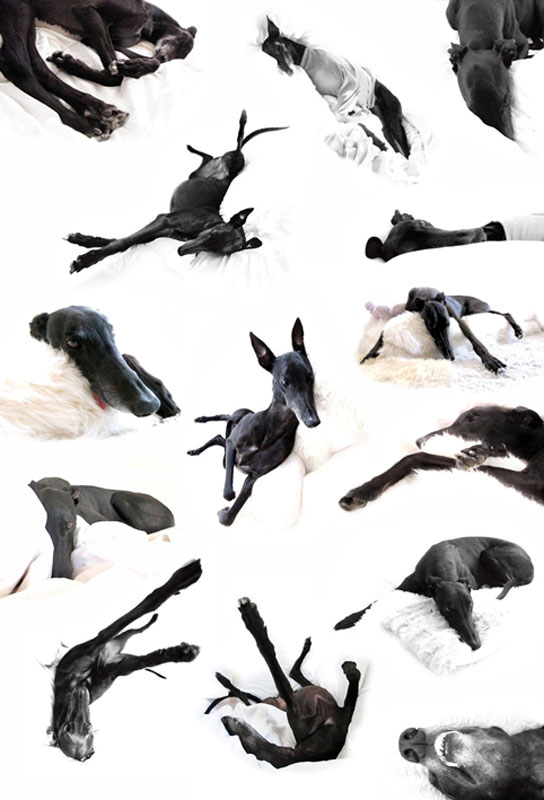
Sonata in Z is a ‘gentle space’, inspired by my autistic hyper sensory quest for sanctuary, and my Greyhound Lucy’s natural ability to seek out and create oases of comfort. Unfolding like a musical sonata, visual images of Lucy in sonorous repose introduce the theme of rest. Please leave your shoes at the threshold as you enter, symbolically shedding conventional notions of social communication. Once inside, we shall not speak in words, but the tranquility is neither silent nor empty, because our senses will lead the way into a different social ecosystem of softly undulating rhythms, patterns, sounds, movements, gestures, textures, smells, tastes and visual conversations. This is our refuge, an alternative empathic resonance, a nonverbal sensory equilibrium – and Lucy and I would like to share our clement space with you.
This slideshow requires JavaScript.
Limited edition photograph posters available for order. Professionally printed on fome-cor or gatorboard. For information on size, print and price details, please contact Dawn-joy at scheherazadessea@gmail.comContinue reading →
My Ph.D dissertation, tentatively entitled, Scheherazade’s Sea – autistic parallel embodiment and elemental empathy, is part of a protracted journey in search for Being: a detailed study of Self and Other, and examination of multidimensional interstices of dynamic, interactive reciprocities.
This research and practice rests upon three fundamental concepts:
Parallel Embodiment,
Endeavour of Empathy, and
Space of Mind, from which emanates Elemental Empathy.
The theoretical foundation for this work is constructed from documented studies in neuroscience, anthropology, the arts and humanities, and personal anecdotal evidence from autistic individuals. At the same time, my artistic practice acts as concretising agency by creating experimental ‘sharable’ spaces that serve not merely to display autism but to invite dynamic, personified communion; connecting individuals across neuro-functional divides. Continue reading →
** Note: This article is more than ten years old, and contains some outdated terminology. My ideas and perspectives have grown, evolved and shifted since, but I am presenting this unedited as a documentation of my journey.
Paper presented in The Arts in Society 2012 conference.
First published by The International Journal of the Arts in Society: Annual Review, Volume 7 (2013), p. 29-39; and in the The International Journal of Arts Theory and History, (Common Ground Publishing).
Art in a Hidden World – creative process and invisible anomaly.
Dawn-joy Leong, 2012.
Abstract: What are the semiotics and meanings of art to a small, hidden sector of society with sensory and cognitive anomalies? How do these idiosyncrasies shape creative process? Much attention is now centred on Autism Spectrum Condition. Researchers in the fields of neurology and psychology are presenting more and more discoveries, as a growing community of autism self-advocates and associates are finding increasingly louder voices in the media and online. Inevitably, claims, counterclaims, heated discussions and bitter disputes abound. In the area of artistic creativity, there has been great interest in the particular talents attributed to individuals with autism. Books, articles and papers are being published on this subject, and an assortment of therapies aimed at developing these abilities are being proffered, while parents grasp at any and every suggestion of hope and reassurance about their children’s latent potentials. However, most of the postulations and assertions emerging about autism and creativity are from the non-autistic observer, and there are, to date, very few practising artist-researchers with autism stepping up on this platform rife with confusion and controversy to present their ideas from the personal vantage point. As an artist and scholar with autism, my interest in the area of multimodality in art is very much entrenched in my idiosyncratic sensory and cognitive profile. The aim of my presentation is to provoke more consideration towards the multisensory dimensions and potentials of artistic practice, as well as make a fledgling contribution of much-needed autobiographical empirical perspective on autism traits and the creative process. For the purpose of concrete illustration, I shall provide a brief overview of my most recent work, Scheherazade’s Sea, as an example of how sensory anomaly and neurodiversity shapes my creativity as an artist-researcher with Autism Spectrum Condition.
My Life with Hypersensitivity and Asperger’s – lecture notes from a session with professionals in special education, specifically about sensory acuity and coping with hypersensitivity. (UNSW, School of Education, 14 May 2012, 5-7pm.) Continue reading →


 Dawn-joy Leong