And Suddenly…

And Suddenly

Cast Photo by Victor Kuansong Zhuang. Thank you for permission to use.

Yesterday, I attended the final performance – a matinee – of “And Suddenly I Disappear: The Singapore ‘d’ Monologues“. My friend, Alvan, has written a brief review of the show here. I like some of his views on it, and I highly recommend a quick visit to his blog post.

This isn’t a review of the play, really, it is more a sensory recollection. Continue reading →

Disabled Leadership in practice

In a previous post, I mused about Disabled Leadership, the great divide between theory and practice that many disabled persons face, and suggested one fundamental element that is crucial to recognition of disabled participants in the conversation on disability: payment as a basic mark of respect. Now, in this brief ‘follow-up’ post, I’d like to provide some straight-forward concrete examples of its practice in the arts and film.

I’ve iterated and reiterated before, and now once more, I am no activist – I have an aversion for confrontational activity, but advocacy is something that most disabled professionals are forced to engage in (in some way or other) due to the dominating climate of ableism and stubborn ignorance surrounding the disabled practitioner. In other words, advocacy – sometimes quite vehement and insistent – is made necessary because disabled practitioners need to clear the debris-strewn paths, clogged channels, and polluted waterways so that we can proceed with our practice. Continue reading →

Reluctant Advocate

I am not an “Autism Activist” – far from it – so, please do not call me that. Thank you. I do support the work of activists, it is a necessary force when things are woefully wrong and a great deal of vim and vigour is needed to create change for the better. It is just that my natural constitution does not fit well with the vivacity required for effective activism. Sometimes, though, I do engage in advocacy. Well, all right, quite often especially of late, but this is not what I deliberately set out to do. I am, first and foremost, an autistic researcher and multi-artist. Unpacking this further, my research interests include (but are not confined to) autism, autistic sensory idiosyncrasies, alternative and elemental empathic resonance, clement spaces of mind and body, and my material practice reflects this research, employing multiple artistic disciplines. I love my research and multi-art practice, and I adore my beloved Lucy Like-a-Charm, the two represent mental, emotional and physical wellbeing and equilibrium to me. Continue reading →

Disabled Leadership in theory & practice

There is increasing talk about Disabled Leadership in the Arts. There are stirrings, positive ones, potentially amazing even, in the arena of the Arts and Disability. (Even in wider fields, for example Autism Research – just reading the Twitter feed coming from IMSAR2018 indicates that level of Actual Autistic participation has increased and that is a cause for hope for a better future in research and practice.)

Excitement and awareness aside, there are still some brass tacks issues to face and tackle head on. Before we can even make that leap into Disabled Leadership, there needs to be some basic concepts of respectful and ethical interactional treatment of disabled people. How do we establish leadership if the non-disabled world cannot even bring themselves to the level of viewing disabled people as human beings worthy of esteem and regard as equal participants in society?

A fundamental topic is that of payment. Yes. Money. And plain simple respect. Let’s start here. Continue reading →

bloviation & the sacrificial lamb

My recent casual blog post, musing on Arts and Disability, and the devastating effects of non-disabled colonisation of the disability conversation, theory and practice in any field, with a focus on the arts, simply because this is my field of research and praxis.

“Perhaps it is time to take the entire conversation back and situate it on our own platform – the Actually Autistic / Actually Disabled stage. One that we choose for ourselves, not that which is designed and built by the non-disabled colonising forces. One in which there is no prerequisite social-political posturing of ambiguous, veiled or hushed up mumblings, no copious mists of gas lighting, and no contemptuous slime of condescension. Just honest truth and a light shining onto a path ahead clear of the debris of gurgling bloviation. Is this even a possibility, I wonder?”

Autism & Neurodiversity in Hong Kong

HKU-CGED-Talk

This slideshow requires JavaScript.

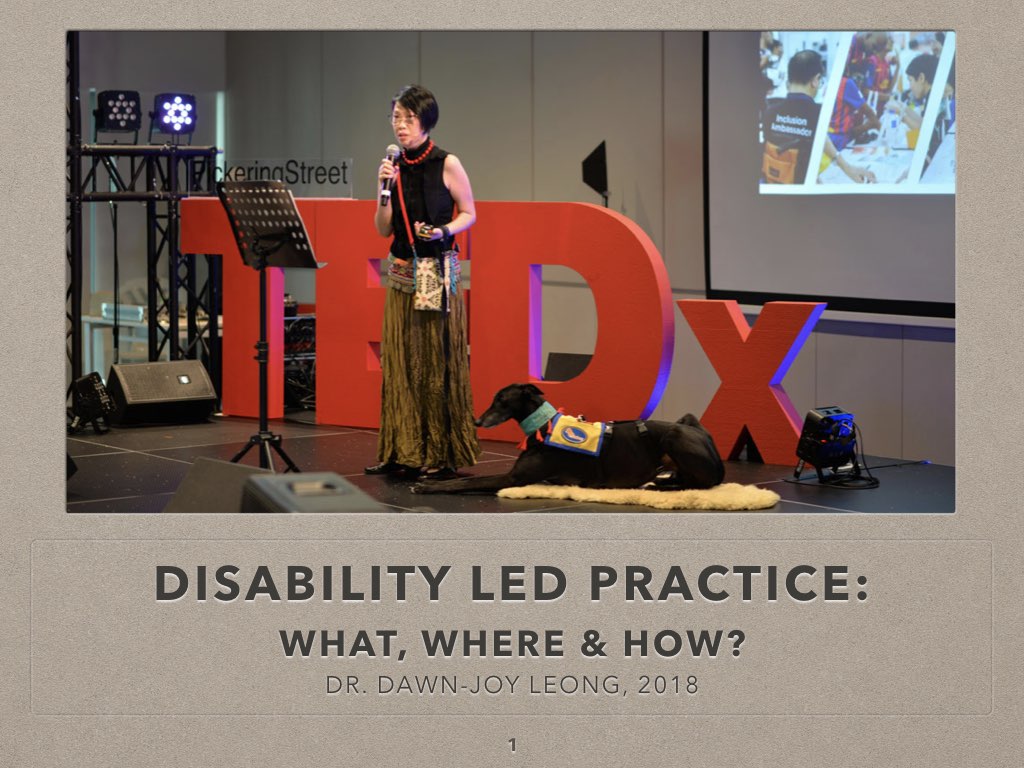
I was in Hong Kong recently, speaking on Autism and Neurodiversity. An amazing week. Hope to see you again soon, Hong Kong!

(For enquiries on speaking engagements, please email: dawnjoy@mac.com)

Space of Mind – Interview

An-Olfactory-Map-of-Sydney_thumbnail-01

I was interviewed by Chloe Watson in this new magazine, Runway – Australian Experimental Art. Thank you, Chloe!

Space of Mind: An Interview with Dawn-joy Leong

“For autistic artist-researcher Dawn-Joy Leong, spaces are vividly coloured by scent, sound, sight and touch — sometimes overwhelming, even disgusting, at other times relaxing, harmonious, or gloriously amplified. Leong explores her heightened sensory experiences of the world through her art and writing, encouraging her audiences to engage with their own sensoriums, at the same time opening up avenues of empathy and communication between ‘neurodiverse’ and ‘neurotypical’”

Autism and the Arts

An excellent article by Katie Sutherland in The Conversation about Autism and the Arts. It is both a relief and a joy when non-autistic writers or producers etc write / make features that are respectful, inclusive and accurate when portraying or talking about Autism. Thank you, Katie Sutherland!

Featuring Snoosphere by Lull Studios, my two works, Clement Space and An Olfactory Map, and Thom & Anglemouse’s Rush Hour at Cloud Heaven. Please click on the link:

“Autism and the arts: making a space for different minds.”

Excerpt:

“Rancid perfume. Stinky babies. Sweaty clothes. Garlic hair. Human bodies putrefying and I think my own is beginning to smell,” declares artist and researcher Dawn-joy Leong in her installation, An Olfactory Map of Sydney, at Customs House in Circular Quay.

At times confronting, at times funny, Leong’s graphic description of the assault of odours while travelling by bus forms a series of video monologues about her sensitivities to smells, sounds, light, colour, tastes and movement.

Leong is autistic and regularly feels overwhelmed due to hyper-sensory perception. This can trigger extreme reactions such as nausea, headache, vertigo and sometimes excruciating pain. Through Leong’s work, the viewer gets a real sense of how exhausting having such a heightened awareness must be, particularly in a world designed for “neurotypicals” – people who are typically wired or non-autistic.