Joint IHL SEN Forum 2018

Singapore

I’ll be speaking in the panel at the Joint IHL SEN (Institute of Higher Learning, Special Education Needs) Forum on 14 September 2018 at the Ngee Ann Polytechnic. The extended title of my panel speech is: “Autism, Neurodiversity and a Neurocosmopolitan Future.” My workshop (taking place after lunch) will be about “Embracing Neurocosmopolitanism: different ways of empathy and communication.”

Free admission but registration necessary.

More details and registration here: Joint IHL SEN Forum 2018
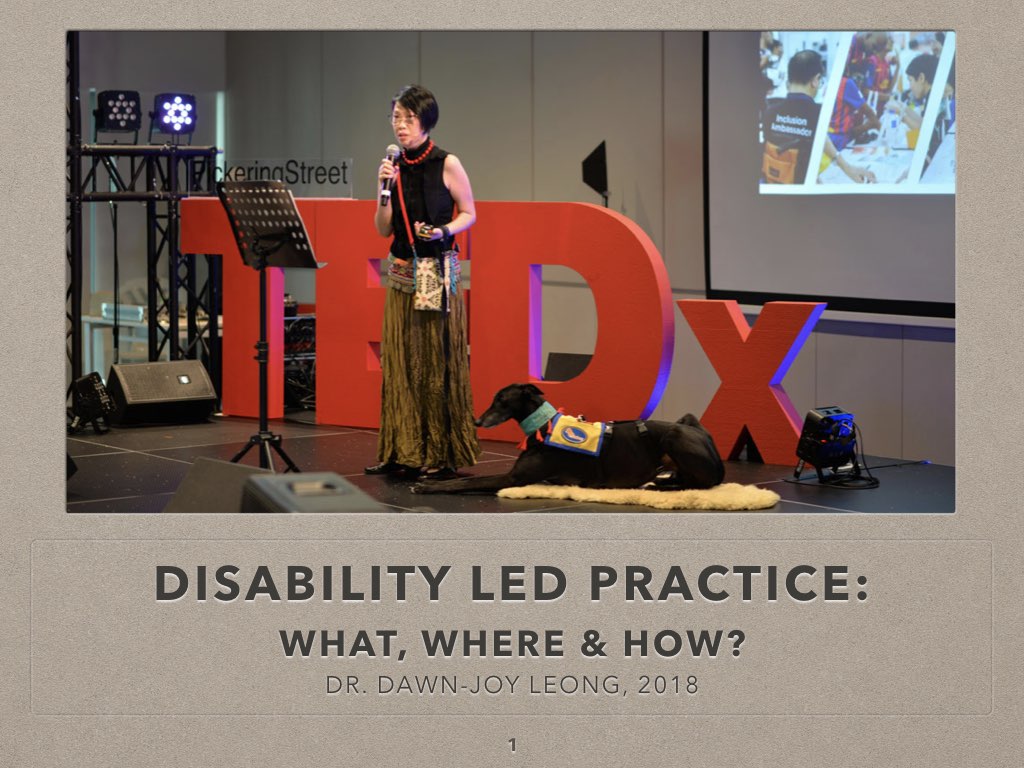
Autistic Thriving @ TEDx

This is the complete unedited script of my TEDx speech, delivered today amidst a flurry of technical failures and farcical-comedic twists. (Read about it here.)

—

AUTISTIC THRIVING
Dawn-joy Leong
4 August 2018
TEDx Pickering Street
Singapore

~

I dance,
Because
I cannot walk,
The ground,
It is too strange.
I must count:
One, two,
One, two, three!

Autistic people are given many different labels by the non-autistic world. One of them is ‘clumsy,’ and by that measure, I suppose I am – it is a conscious effort for me to walk in a straight line, navigate bumpy surfaces, and stroll and chat at the same time. Yet, how does ‘clumsiness’ explain the ability to dance? When there is music, my body becomes freed from the tyranny of the walk, and the ground doesn’t seem so daunting anymore. Continue reading →

Disabled Leadership in practice

In a previous post, I mused about Disabled Leadership, the great divide between theory and practice that many disabled persons face, and suggested one fundamental element that is crucial to recognition of disabled participants in the conversation on disability: payment as a basic mark of respect. Now, in this brief ‘follow-up’ post, I’d like to provide some straight-forward concrete examples of its practice in the arts and film.

I’ve iterated and reiterated before, and now once more, I am no activist – I have an aversion for confrontational activity, but advocacy is something that most disabled professionals are forced to engage in (in some way or other) due to the dominating climate of ableism and stubborn ignorance surrounding the disabled practitioner. In other words, advocacy – sometimes quite vehement and insistent – is made necessary because disabled practitioners need to clear the debris-strewn paths, clogged channels, and polluted waterways so that we can proceed with our practice. Continue reading →

Disabled Leadership in theory & practice

There is increasing talk about Disabled Leadership in the Arts. There are stirrings, positive ones, potentially amazing even, in the arena of the Arts and Disability. (Even in wider fields, for example Autism Research – just reading the Twitter feed coming from IMSAR2018 indicates that level of Actual Autistic participation has increased and that is a cause for hope for a better future in research and practice.)

Excitement and awareness aside, there are still some brass tacks issues to face and tackle head on. Before we can even make that leap into Disabled Leadership, there needs to be some basic concepts of respectful and ethical interactional treatment of disabled people. How do we establish leadership if the non-disabled world cannot even bring themselves to the level of viewing disabled people as human beings worthy of esteem and regard as equal participants in society?

A fundamental topic is that of payment. Yes. Money. And plain simple respect. Let’s start here. Continue reading →

bloviation & the sacrificial lamb

My recent casual blog post, musing on Arts and Disability, and the devastating effects of non-disabled colonisation of the disability conversation, theory and practice in any field, with a focus on the arts, simply because this is my field of research and praxis.

“Perhaps it is time to take the entire conversation back and situate it on our own platform – the Actually Autistic / Actually Disabled stage. One that we choose for ourselves, not that which is designed and built by the non-disabled colonising forces. One in which there is no prerequisite social-political posturing of ambiguous, veiled or hushed up mumblings, no copious mists of gas lighting, and no contemptuous slime of condescension. Just honest truth and a light shining onto a path ahead clear of the debris of gurgling bloviation. Is this even a possibility, I wonder?”

Autism & Mental Wellbeing

Back in Singapore! Hit the ground running. Two more lectures upon my return from Hong Kong.

“Autism & Neurodiversity – lived-experience & the way forward” – NUS Psychology. Thank you, Dr. Iliana Magiati, for the invitation to address your class of future psychologists on neurodiversity and actual autistic insights into autism.


“Autism, Mental Wellbeing & Higher Education” – NUS Office of Student Affairs. An important topic. Autistic students in universities have to navigate a minefield of sensory, social, political & executive function complexities. Specific considerations and supports / accommodations are necessary. First, let’s look at autism from the viewpoint of Neurodiversity, ditch that pathological model, it doesn’t help at all!

(For enquiries on talks / workshops / training sessions, please email me at dr.dawnjoyleong@gmail.com)

Autism & Neurodiversity in Hong Kong

HKU-CGED-Talk

This slideshow requires JavaScript.

I was in Hong Kong recently, speaking on Autism and Neurodiversity. An amazing week. Hope to see you again soon, Hong Kong!

(For enquiries on speaking engagements, please email: dawnjoy@mac.com)

Space of Mind – Interview

An-Olfactory-Map-of-Sydney_thumbnail-01

I was interviewed by Chloe Watson in this new magazine, Runway – Australian Experimental Art. Thank you, Chloe!

Space of Mind: An Interview with Dawn-joy Leong

“For autistic artist-researcher Dawn-Joy Leong, spaces are vividly coloured by scent, sound, sight and touch — sometimes overwhelming, even disgusting, at other times relaxing, harmonious, or gloriously amplified. Leong explores her heightened sensory experiences of the world through her art and writing, encouraging her audiences to engage with their own sensoriums, at the same time opening up avenues of empathy and communication between ‘neurodiverse’ and ‘neurotypical’”

Reflections on the neurodiverse city

Leong_4(1)

My article for Artlink Magazine, “Reflections on the neurodiverse city,” is now online.

Excerpt:

“Many autistics experience “body‑in‑space” challenges. The opening poem describes my own proprioceptive quirk: I can dance, but the simple task of walking along the pavement without tripping requires a conscious rhythmic pattern in my mind, usually in the form of a song or a tune. Other idiosyncrasies inherent to autism include extreme sensitivity to the visual, auditory, olfactory and tactile senses. Lights, colours, sounds, vibrations, smells, tastes and textures may separately or in complex confluence trigger extreme reactions like nausea, headache, vertigo and even excruciating pain. The mental propensity towards precision – that is, noticing things in greater detail, also heightens sensory reception and reaction. A common unifying theme in this richly woven, polyrhythmic and highly chromatic existence is that of anxiety. Coping with life in an environment not designed for and conflicting with native autistic modalities, the autistic person is constantly in a state of stress.”